Posted on Leave a comment

Top Art Festivals in South Africa 2025 for Collectors & Decorators

Crowded South African art festival with booths and collectors in 2025

South Africa’s art festivals have always pulled crowds with colour and creativity. Some people reckon nothing beats the National Arts Festival, drawing in over 30,000 visitors from 58 countries and filling Makhanda’s streets with raw talent. But the surprise is that it’s not just about the numbers or the spectacle. The real magic sits in the bold new trends and unexpected artistic collaborations shaking up the art world in 2025, giving collectors and decorators more than just beautiful pieces for their walls.

Table of Contents

Quick Summary

Takeaway Explanation
Explore South Africa’s top art festivals in 2025 Engage with vibrant cultural experiences at key festivals, including the National Arts Festival and Cape Town Art Fair.
Watch for trends in indigenous art Expect a revival of indigenous cultures showcased through contemporary practices and storytelling at art festivals.
Prioritize sustainable art practices Collect artworks that reflect eco-friendly and innovative material use, aligning with growing environmental concerns.
Invest in artistic provenance documentation Keep detailed records of your collections for insurance and resell value; documentation is crucial for reputable collecting.
Utilize both physical and online art platforms A multifaceted approach to sourcing art enhances collection diversity; attend fairs and explore digital galleries.

Must-Visit Art Festivals in 2025

Art collectors and decorators seeking vibrant cultural experiences in 2025 will find South Africa’s art festivals an extraordinary showcase of creativity and artistic innovation. These festivals represent more than mere exhibitions they are dynamic platforms where artistic expression meets cultural celebration.
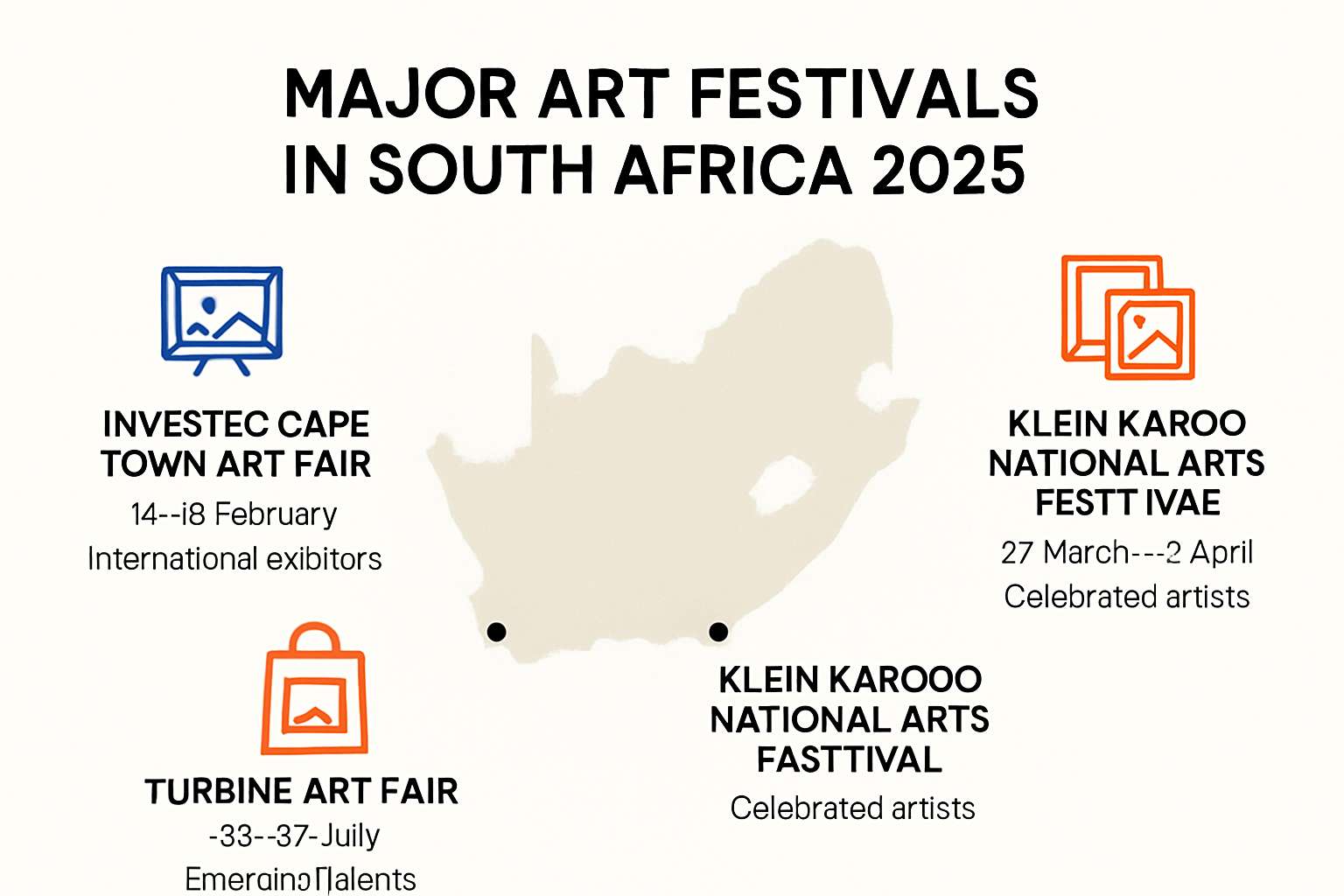
Map of top 2025 South African art festivals with details

National Arts Festival: The Continental Cornerstone

The National Arts Festival stands as Africa’s premier artistic gathering, scheduled from 26 June to 6 July 2025 in Makhanda. This extraordinary event attracts thousands of art enthusiasts from around the world, offering an unprecedented platform for contemporary South African artists. Collectors can expect an immersive experience featuring diverse artistic mediums including visual arts, performance, music, and interactive installations.

Professional art collectors will appreciate the festival’s curated exhibitions that highlight emerging talent and established artists. The event provides unique opportunities to discover original artworks directly from creators, making it an essential destination for those looking to expand their collections with authentic south-african artistic expressions.

Cape Town Art Fair: Contemporary Art Showcase

Another critical event for art collectors is the Cape Town Art Fair, which has consistently positioned itself as a premier contemporary art platform. In 2025, the fair promises to deliver an exceptional curation of local and international artistic works. Art decorators will find immense inspiration in the diverse range of styles and mediums presented, from traditional paintings to cutting-edge multimedia installations.

The fair attracts international galleries and collectors, creating a global marketplace for south-african art. Visitors can expect expertly curated sections showcasing different artistic movements, providing deep insights into contemporary artistic trends. For decorators seeking unique pieces that tell compelling visual stories, this festival offers unparalleled selections.

Johannesburg International Mozart Festival: Unexpected Artistic Convergence

While primarily known for classical music, the Johannesburg International Mozart Festival has evolved to become a multidisciplinary artistic celebration. In 2025, the festival will expand its scope to include visual arts, creating unexpected dialogues between musical and visual creative expressions. Art collectors interested in interdisciplinary experiences will find this festival particularly compelling.

The festival represents an innovative approach to artistic presentation, demonstrating how different creative forms can intersect and enhance each other. For decorators and collectors, this means access to unique artistic perspectives that challenge traditional categorizations.

These festivals offer more than mere exhibitions they are vibrant celebrations of south-african artistic creativity. Each event provides collectors and decorators with extraordinary opportunities to discover exceptional artworks, connect with artists, and immerse themselves in the dynamic cultural landscape of contemporary south-african art.

Discover more about south-african artistic trends that are shaping the art world in 2025 and beyond.

The south-african art festival landscape in 2025 reveals fascinating transformations that promise to captivate art collectors and decorators with innovative approaches to creative expression and cultural representation.

Indigenous Renaissance and Cultural Storytelling

The emerging trend of indigenous artistic representation takes center stage in 2025, with festivals like the AIR Festival highlighting contemporary interpretations of traditional artistic practices. According to festival organizers, the event hosted 174 artists and 46 vendors, celebrating indigenous music, dance, and artistic heritage with unprecedented depth and complexity.

Art collectors will find remarkable value in works that authentically represent south-african cultural narratives. These pieces transcend mere aesthetic appeal, offering profound cultural insights and historical connections. Decorators can expect textile designs, sculptural works, and visual art that integrate traditional techniques with modern sensibilities.
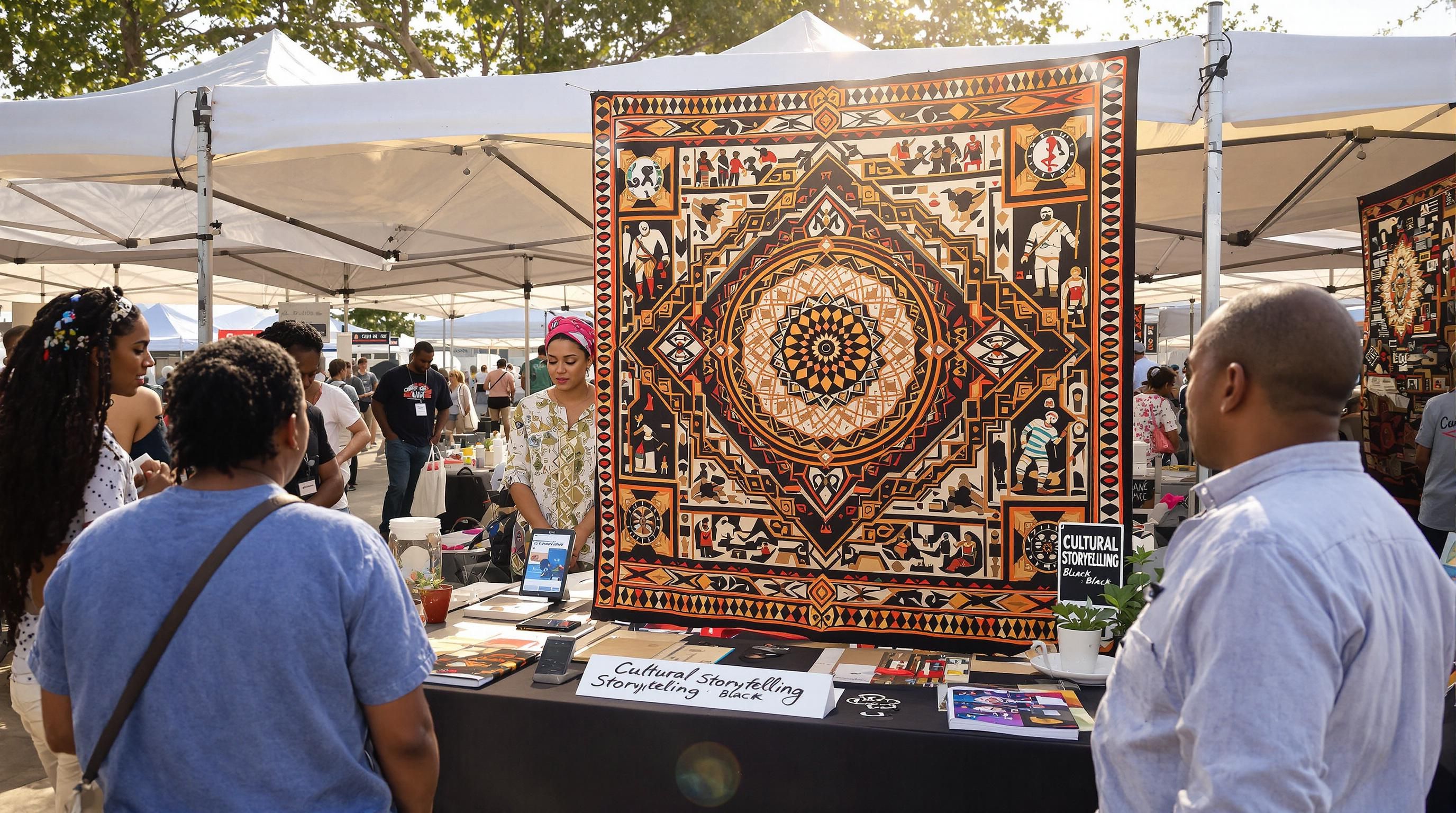
Artist and visitors discuss textile art, highlighting cultural storytelling

Sustainable and Innovative Material Practices

The Investec Cape Town Art Fair 2025 edition dramatically showcased a significant shift towards sustainable and experimental artistic practices. With 124 international exhibitors presenting works by 500 artists from 58 countries, the fair attracted over 30,000 visitors interested in cutting-edge artistic innovation.

Emergent trends include a remarkable resurgence of fiber art, emphasizing eco-conscious material selection and innovative crafting techniques. Artists are increasingly exploring recycled materials, organic textiles, and regenerative design principles. For art collectors, this means acquiring pieces that not only demonstrate artistic excellence but also reflect contemporary environmental consciousness.

Interdisciplinary and Thematic Artistic Expressions

The National Arts Festival in Makhanda embraced the theme ‘Vivid. Bold. Unfiltered.’ for its 2025 edition, signaling a powerful trend towards interdisciplinary and socially engaged artistic practices. The festival’s program blended local and international works, with a particular focus on performances that reflect contemporary societal themes.

This approach indicates a growing trend where art transcends traditional medium boundaries. Collectors and decorators can anticipate works that integrate multiple artistic disciplines dance, theatre, visual arts, and multimedia installations creating rich, complex narratives that challenge conventional artistic categorizations.

These emerging trends demonstrate that south-african art festivals in 2025 are not merely exhibitions but dynamic platforms for cultural dialogue, innovation, and transformative artistic expression. Art collectors and decorators stand at the exciting intersection of creativity, cultural heritage, and contemporary global artistic movements.

Learn more about contemporary south-african artistic innovations that are reshaping the artistic landscape.

Tips for Art Collectors and Decorators

Navigating the vibrant south-african art festival scene requires strategic approach and nuanced understanding. Art collectors and decorators can maximize their experience and investment potential by employing targeted strategies that go beyond mere aesthetic appreciation.

Strategic Documentation and Provenance

Professional art collectors understand that comprehensive documentation is crucial. According to the Smithsonian American Art Museum, maintaining detailed records for each artwork is essential. These records should include high-resolution color photographs, precise purchase details, comprehensive artist information, and professional condition reports.

The documentation process serves multiple critical purposes. For insurance purposes, detailed records provide definitive proof of artwork ownership and value. In potential scenarios of theft or damage, these comprehensive documents become invaluable. Decorators and collectors should develop a systematic approach to archiving artwork information, potentially using digital platforms that offer secure, organized storage solutions.

Budgeting and Investment Considerations

Successful art acquisition demands sophisticated financial planning. Art collectors must balance aesthetic appreciation with investment potential. This requires deep research into emerging artists, understanding market trends, and developing a nuanced comprehension of artistic value beyond immediate visual appeal.

At art festivals, strategic collectors should:

  • Set clear budget parameters before attending
  • Research artists and their market trajectory
  • Understand potential artwork appreciation potential
  • Consider long-term preservation and conservation costs

Explore expert insights on south-african art investment strategies that can guide your collecting journey.

Preservation and Display Techniques

Art preservation requires specialized knowledge that goes beyond aesthetic considerations. Different artistic mediums demand unique conservation approaches. South-african artworks, often incorporating traditional and contemporary materials, require particularly careful handling.

Decorators should consider:

  • Appropriate lighting conditions that prevent artwork degradation
  • Temperature and humidity control in display spaces
  • Professional framing and mounting techniques
  • Regular professional assessment of artwork condition

The Smithsonian Associates Art Collectors Program emphasizes that meticulous record-keeping aids not just in immediate preservation but also in future valuation and potential resale decisions.

South-african art festivals offer extraordinary opportunities for collectors and decorators to discover unique pieces. By approaching these events with strategic preparation, comprehensive documentation, and informed investment perspectives, art enthusiasts can transform their collecting experience from casual browsing to sophisticated cultural engagement.

Where to Source Unique South African Art

Sourcing exceptional south-african art requires strategic navigation through diverse platforms and events that showcase the country’s rich artistic landscape. Art collectors and decorators seeking distinctive pieces will find multiple avenues to discover remarkable artworks that capture the essence of contemporary african creativity.

Premier Art Fairs and Exhibitions

The Investec Cape Town Art Fair, scheduled for February 21-23, 2025, stands as Africa’s largest international art fair. With over 100 exhibitors representing established galleries and emerging artists, this event provides an unparalleled platform for discovering unique south-african artworks. The fair’s dynamic program includes curated exhibitions exploring contemporary themes in african art, offering collectors direct access to groundbreaking artistic expressions.

Similarly, the RMB Latitudes Art Fair in Johannesburg transforms the three-acre Shepstone Gardens into a comprehensive celebration of african art. Running from May 23-25, 2025, this annual event showcases contemporary art practices through meticulously curated exhibitions across various mediums. Collectors can expect an immersive experience that goes beyond traditional gallery presentations.

Specialized Art Platforms and Galleries

The FNB Art Joburg, scheduled for September 5-7, 2025, represents another critical destination for art enthusiasts. Since its inception in 2008, this premier art fair has become a vital platform for artists, galleries, and collectors. The 2025 edition promises an exciting lineup featuring both established and emerging artists, with curated exhibitions that provoke thought and inspire dialogue about socio-political narratives embedded in african art.

Art collectors should also explore specialized online platforms and local galleries that represent emerging and established south-african artists. These platforms often provide more intimate connections with artists and offer deeper insights into the creative processes behind unique artworks.

Online and Virtual Art Acquisition Strategies

In the digital age, art acquisition has expanded beyond physical spaces. Online platforms now offer sophisticated ways to discover and purchase south-african art. Virtual exhibitions, online galleries, and digital art fairs have become increasingly sophisticated, providing high-resolution imagery, detailed artist backgrounds, and secure purchasing mechanisms.

Explore our curated guide to south-african artistic innovations that can help collectors and decorators navigate the complex landscape of contemporary african art.

Successful art sourcing requires a multifaceted approach. By combining physical art fair attendance, gallery visits, and strategic online research, collectors can build remarkable collections that represent the dynamic and evolving landscape of south-african artistic expression. Each artwork becomes not just a decorative piece but a narrative of cultural richness and contemporary creativity.

To help readers compare the major art festivals discussed, the following table summarises key features, focus, and highlights:

Festival Dates Location Artistic Focus Notable Features
National Arts Festival 26 Jun – 6 Jul 2025 Makhanda Visual & Performing Africa’s biggest arts gathering; 30,000+ visitors, 58 countries, all mediums
Cape Town Art Fair Feb 2025 Cape Town Contemporary Visual International galleries, cutting-edge curation, global collector base
Johannesburg International Mozart Festival 2025 Johannesburg Music & Visual Arts Interdisciplinary focus; unique blend of music and visual creativity
RMB Latitudes Art Fair 23–25 May 2025 Johannesburg Contemporary Art Immersive exhibitions in gardens, diverse African creators
FNB Art Joburg 5–7 Sep 2025 Johannesburg Various Mediums Leading fair for emerging and established artists/galleries

Below is a table summarising the key statistics and numbers associated with major 2025 South African art festivals and trends, as mentioned in the article:

Event/Festival Number of Artists/Exhibitors Number of Visitors Number of Countries Additional Info
National Arts Festival 30,000+ 58 Visual, performing, immersive arts
AIR Festival 174 artists, 46 vendors Indigenous focus
Investec Cape Town Art Fair 124 exhibitors, 500 artists 30,000+ 58 Sustainability trends
RMB Latitudes Art Fair 100+ exhibitors Outdoor garden setting

Frequently Asked Questions

What are the top art festivals to attend in South Africa in 2025?

South Africa’s top art festivals in 2025 include the National Arts Festival in Makhanda, the Cape Town Art Fair, the Johannesburg International Mozart Festival, the RMB Latitudes Art Fair, and the FNB Art Joburg. Each of these festivals showcases diverse artistic expressions and provides unique opportunities for art collectors and decorators.

When is the National Arts Festival taking place in 2025?

The National Arts Festival is scheduled to take place from June 26 to July 6, 2025. It is Africa’s premier artistic gathering and attracts thousands of visitors and artists from around the world.

How can art collectors benefit from attending South African art festivals?

Art collectors can benefit by discovering unique artworks, connecting directly with artists, and gaining insights into current artistic trends and market values. Festivals provide opportunities for collectors to expand their collections with authentic pieces that reflect South African artistry.

Decorators should look for trends such as indigenous cultural storytelling, sustainable art practices using innovative materials, and interdisciplinary artistic expressions. These trends highlight the evolving nature of contemporary South African art and offer opportunities for unique decorative pieces.

Discover Rare South African Art Without the Festival Rush

Are you inspired by the creative buzz and emerging trends highlighted in South Africa’s top art festivals but feel overwhelmed by the sheer scale or logistics of attending every show? Many collectors and decorators face the frustration of missing out on original works and exclusive pieces due to travel restrictions, time limits, or crowded spaces. Your passion for indigenous storytelling, sustainable art practices, and cutting-edge pieces should not be limited by your circumstances.

https://art-online.co.za

Imagine curating your own collection from the country’s most renowned artists—all in one place and on your terms. With Art Online, you gain access to an unrivalled selection of authentic South African artworks. This is where the artistic innovation and cultural depth you saw at major festivals comes directly to you. Avoid missing out on one-of-a-kind creations. Visit South Africa’s largest online art gallery today and secure pieces that reflect today’s top festival trends. Take control of your collection now before the most sought-after works are gone.
Posted on Leave a comment

Buying Art for Investment in South Africa: 2025 Guide

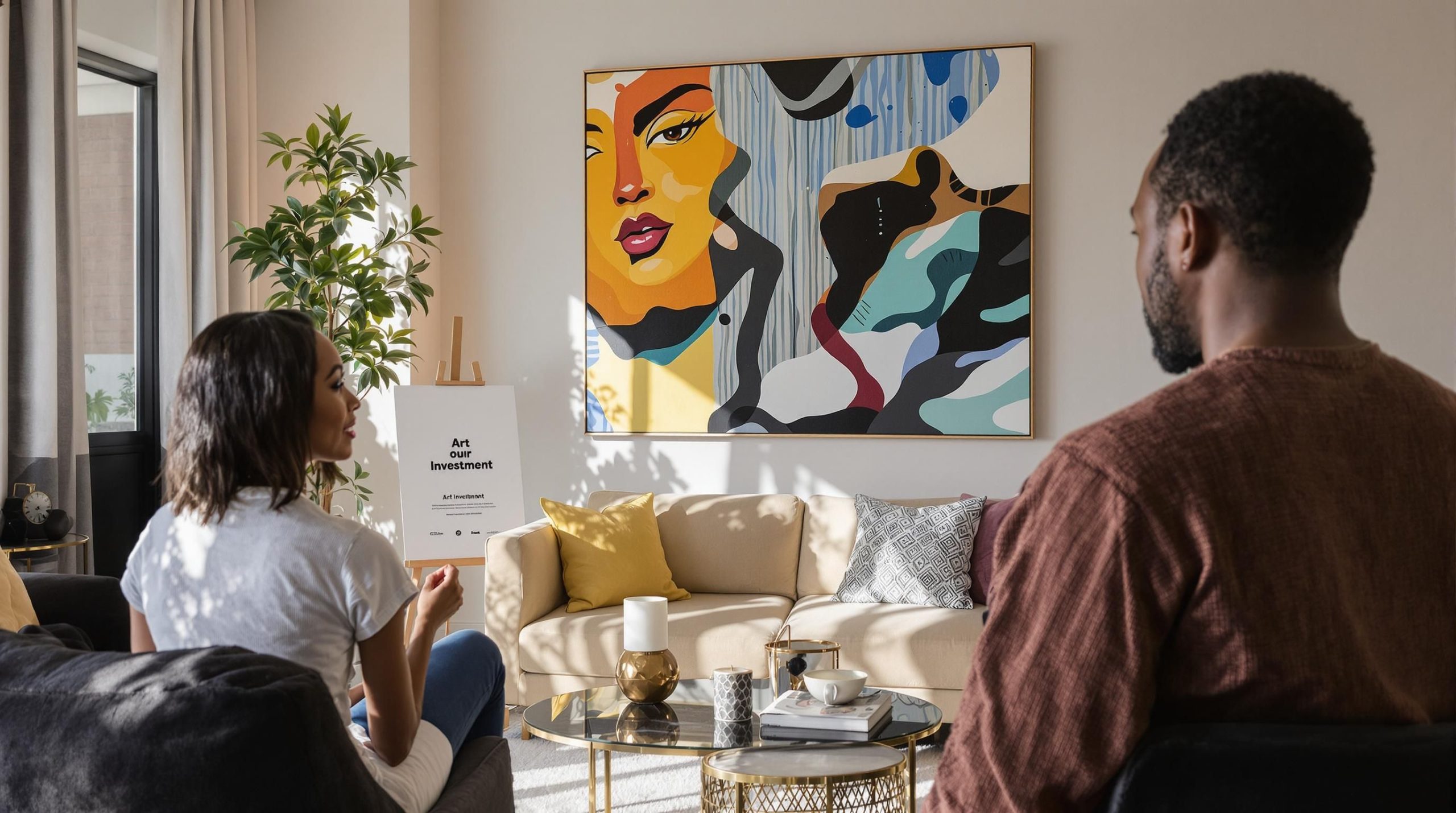
Couple admiring South African art in luxury home with 'Art Investment' signage

Buying art in South Africa is no longer just about decorating your lounge. In the past five years, international buyers of South African art have jumped by 60 percent, showing a serious shift in global interest. Forget the old view that art is risky or only for the rich. These days, smart investors are turning to local art to diversify their portfolios while also getting a piece of history for themselves.

Table of Contents

Quick Summary

Takeaway Explanation
Invest in Art for Diversification Art can diversify investment portfolios, adding value independent of stock market trends.
Research Artist Reputation Prioritize artists with established names and proven sales history to enhance investment success.
Understand Market Dynamics Stay informed on art market trends to identify potential investment opportunities and emerging talents.
Focus on Rarity for Value Unique and rare artworks generally appreciate better than common pieces, enhancing investment returns.
Document Art Acquisitions Carefully Maintain clear records of ownership, provenance, and authenticity to protect your investment’s value.

Why Buy Art for Investment

Investing in art represents a nuanced financial strategy that extends beyond traditional investment vehicles. While stocks and bonds offer predictable returns, art provides a unique opportunity to diversify investment portfolios with potential long-term value appreciation.

The Financial Dynamics of Art Investment

Art investment is not simply about purchasing beautiful pieces but understanding their potential economic value. According to a study in the South African Journal of Economic and Management Sciences, art prices correlate with broader economic indicators like stock market performance and national wealth. This connection suggests art can function as a sophisticated store of value during economic fluctuations.

The Financial Times research highlights that while art investments might yield lower returns compared to traditional equities, they offer unique advantages. Wealthy families often incorporate art into their portfolios not just for potential financial gains but for prestige and personal enjoyment.

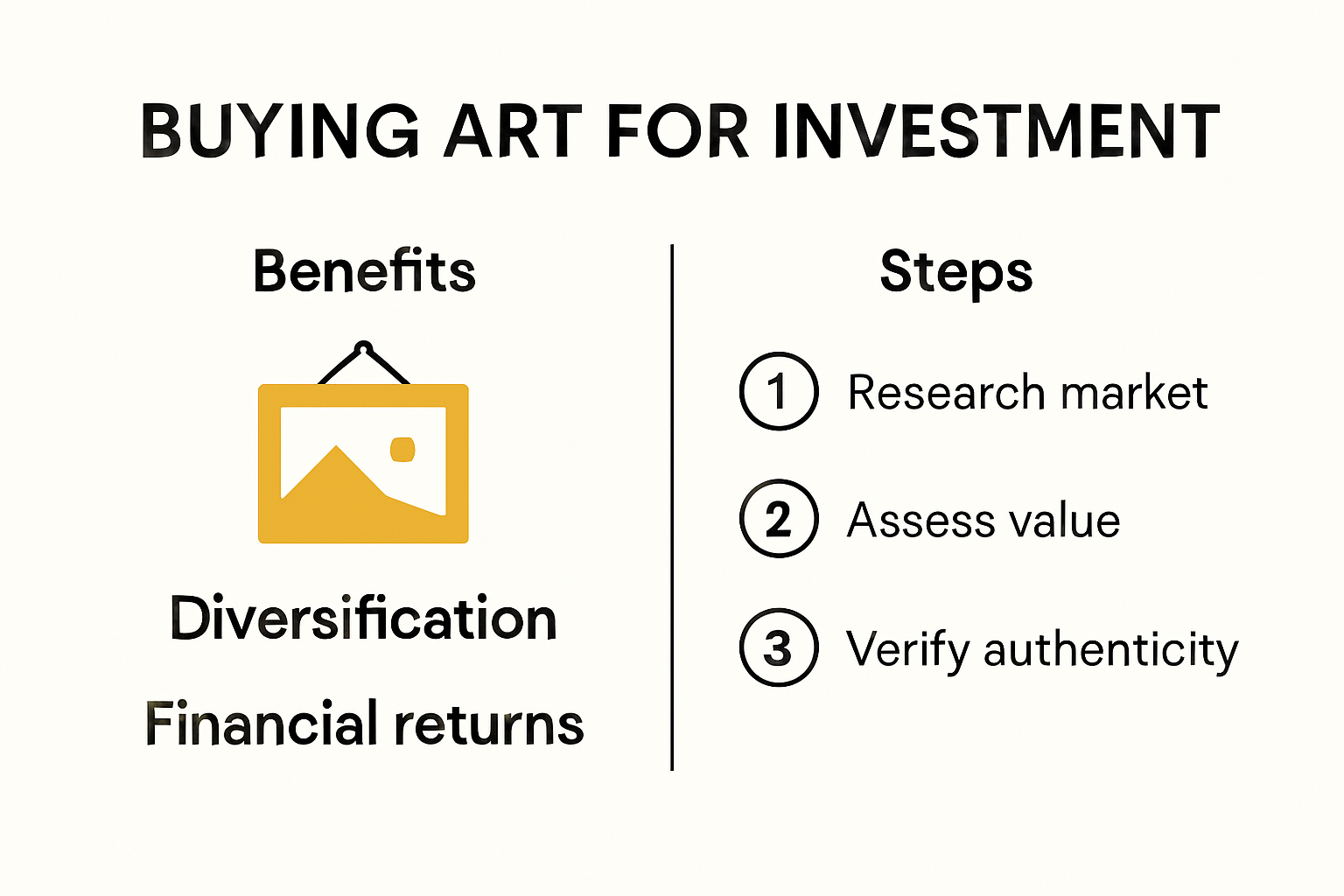
Infographic showing benefits and steps of buying art for investment

Diversification and Portfolio Strategy

A compelling research paper titled ‘Modern Portfolio Diversification’ demonstrates that allocating approximately 20% of investment capital to blue-chip art can potentially enhance risk-adjusted returns by around 20%. This approach maintains portfolio volatility similar to established market indices like the S&P 500.

Investors should recognize that not all artworks appreciate equally. Learn more about selecting valuable art pieces to make informed investment decisions. The key lies in understanding artist reputation, artwork provenance, market trends, and historical sales performance.

Considerations for Art Investment

Successful art investment requires thorough research and a strategic approach. Factors to consider include:

  • Artist Reputation: Works by established or emerging artists with growing recognition
  • Artwork Condition: Pristine pieces typically command higher values
  • Provenance: Clear documentation of an artwork’s history and ownership
  • Market Trends: Understanding contemporary art market dynamics

While art can be a compelling investment, it demands patience, expertise, and a long-term perspective. Potential investors should approach art acquisition with both aesthetic appreciation and financial acumen, recognizing that true value emerges from a combination of artistic merit and market demand.

To help clarify and summarize the considerations for art investment described above, here’s a checklist table you can reference when evaluating potential art acquisitions:

Consideration Description Completed (✔/✗)
Artist Reputation Is the artist established or gaining recognition?
Artwork Condition Is the piece in pristine condition?
Provenance Is there clear history and ownership documentation?
Market Trends Are you aware of the latest market dynamics?
Research & Expert Input Have you conducted thorough research and consulted art professionals?
Patience & Long-term Outlook Are you prepared to invest over a long period for value appreciation?

How to Choose Profitable Artworks

Selecting profitable artworks requires a strategic approach that balances artistic merit, market trends, and investment potential. While no investment is guaranteed, certain principles can guide art investors towards more promising acquisitions.

Understanding Artist and Market Dynamics

Research from the Arte-Blue Chip Index reveals critical insights into art investment. By analyzing over 81,000 public transactions from 1990 to 2024, the study demonstrates that strategic selection of blue-chip artists can significantly enhance portfolio performance. Investors should focus on artists with established reputations, consistent market presence, and demonstrated value appreciation.

Key Selection Criteria:

  • Track record of previous sales
  • Critical recognition in art circles
  • Emerging or established artist status
  • Consistent artistic style and innovation

Rarity and Uniqueness

Interestingly, research on collectible markets indicates that rarity substantially influences artwork value. Analysis of 3.7 million transactions across 1.4 million NFT collections reveals that rarer pieces consistently command higher prices and generate more stable returns. This principle applies equally to traditional art investments.
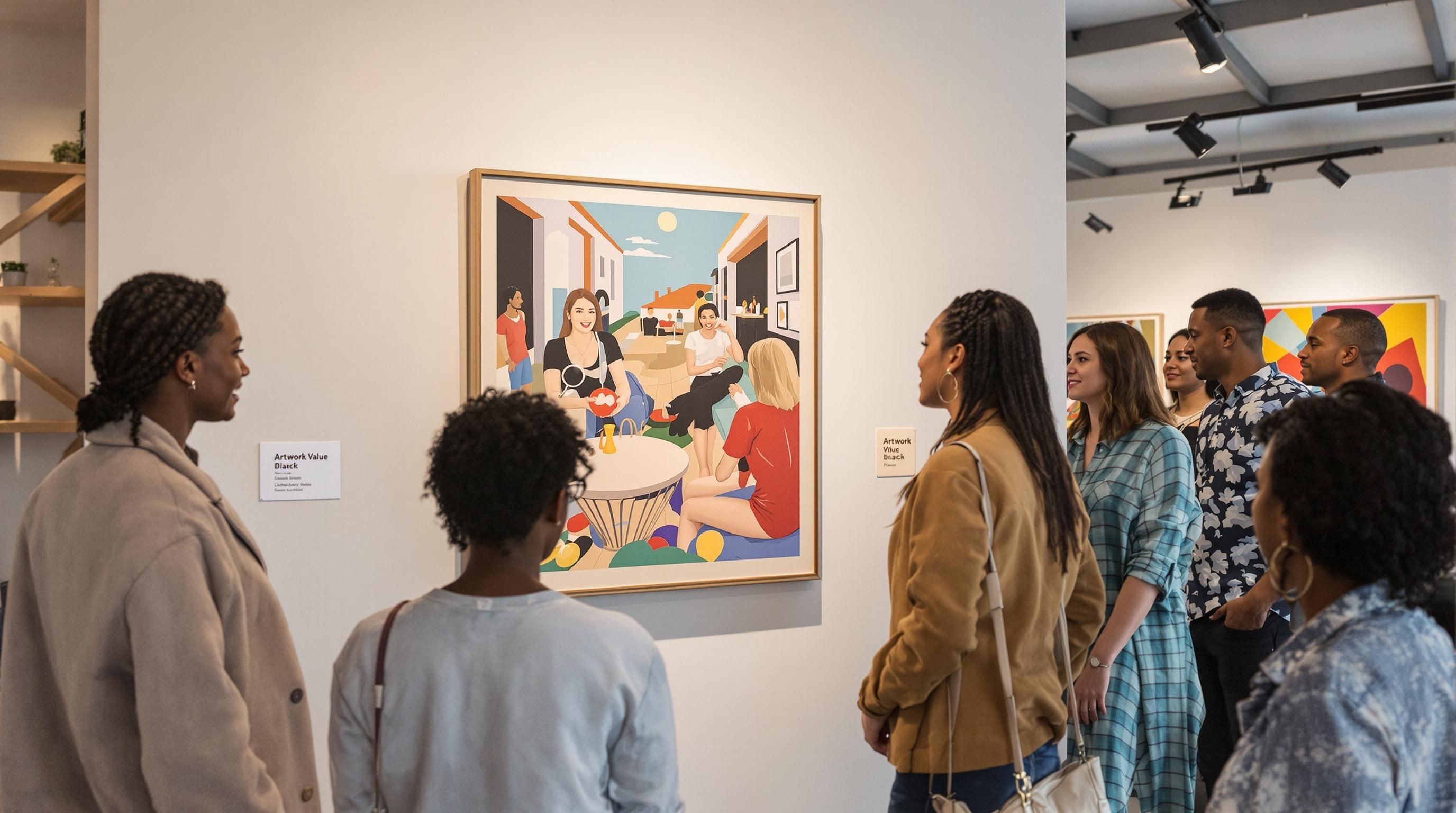
Gallery curator showing unique artwork with 'Artwork Value' signage
Discover insights into art valuation to understand how unique characteristics impact an artwork’s potential financial performance. Factors like limited edition prints, experimental techniques, or works representing significant cultural moments can dramatically increase an artwork’s investment appeal.

The art investment landscape continues evolving, with innovative approaches emerging. The Financial Times highlights the rise of art investment funds that strategically target undervalued artists, often focusing on historically marginalized creators such as women and artists of color.

Practical strategies for choosing profitable artworks include:

  • Diversifying across different artists and styles
  • Monitoring emerging talent in contemporary art scenes
  • Understanding historical price trajectories
  • Considering cultural and social significance of artworks

Successful art investment demands patience, continuous learning, and a nuanced understanding of both artistic and financial ecosystems. While potential returns can be significant, investors must approach art acquisition with thorough research, expert consultation, and a long-term perspective.

The following summary table contrasts key factors to consider when selecting profitable artworks, helping readers compare artist, rarity, and market aspects at a glance:

Factor Why It Matters How To Evaluate
Artist Reputation Established artists often have more stable value Research previous sales and recognition
Rarity/Uniqueness Rare works often command higher prices Look for limited editions or unique styles
Market Trends Demand shifts influence price appreciation Track auctions & contemporary trends
Cultural Significance Works tied to social/cultural themes can gain value Assess societal relevance

South African Art Market Insights

The South African art market represents a dynamic and evolving landscape, characterized by growing global recognition, increasing digital accessibility, and emerging opportunities for investors and collectors alike.

Market Growth and Global Recognition

Recent developments highlight the remarkable trajectory of South African art on the international stage. Discover our curated guide to prominent artists who are driving this transformation. According to the Financial Times, African modernist artists are now gaining unprecedented recognition, with recent events like the Venice Biennale featuring seven 20th-century African artists for the first time.

The art market’s expansion is evident in the performance of prominent auction houses. Strauss & Co reported sales totalling R354 million ($20.6 million) in 2022, demonstrating robust market resilience despite challenging economic conditions. Notably, nine of their top 20 lots sold to international clients, indicating growing global interest in South African art.

Digital Transformation and Market Dynamics

The Covid-19 pandemic accelerated significant changes in the art market. Research from Wanted Online reveals a transformative shift towards online platforms, with digital sales platforms becoming increasingly sophisticated. The study highlights key trends:

  • Diversification of art buyer demographics
  • Increased spending by online-first buyers
  • Growing importance of sociopolitical factors in artwork selection

Frank Kilbourn, Strauss & Co’s chairperson, attributes the market’s resilience to a maturing art ecosystem. The emergence of world-class museums like the Zeitz Museum of Contemporary Art Africa and the Norval Foundation has further enhanced South Africa’s artistic credibility.

Investment Potential and Future Outlook

The South African art market offers unique investment opportunities. Global interest has surged, with international buyers increasing by 60% over the past five years. Artists are addressing contemporary issues in thought-provoking and enduring ways, creating artworks that transcend mere aesthetic value.

Key considerations for investors include:

  • The maturity of the South African art ecosystem
  • Increasing global recognition of local artists
  • Robust digital sales platforms
  • Emerging museum infrastructure

While the global art market study by Art Basel and UBS suggests Africa contributes only 8% to global art sales, the potential for growth remains significant. South Africa, with its advanced commercial arts sector, stands at the forefront of this emerging market.

Investors and collectors should approach the South African art market with an understanding of its unique dynamics. The combination of digital innovation, global recognition, and a rich artistic heritage makes this market an exciting frontier for art investment.

Tips for Art Collectors and Decorators

Art collecting and decorating represent sophisticated practices that blend aesthetic appreciation with strategic investment. Understanding the nuanced approach to acquiring and displaying artworks can transform both personal spaces and investment portfolios.

Strategic Acquisition and Documentation

The foundation of successful art collecting lies in meticulous documentation and provenance tracking. Kiplinger emphasizes that a comprehensive history documenting every ownership transfer is crucial for establishing an artwork’s authenticity and value. This detailed lineage not only proves the piece’s legitimacy but also enhances its collectible significance.

Explore our guide to notable South African artists to understand the context and background of potential art acquisitions. When collecting, prioritize obtaining:

  • Certificates of authenticity
  • Detailed ownership history
  • Professional appraisal documentation
  • Artist’s background and exhibition history

Investment and Display Considerations

The Financial Times highlights a significant shift in art collecting from passion-driven curation to investment-focused strategies. This transformation is driven by rising demand from affluent collectors and professional investors who view art as a financial asset.

Key considerations for collectors and decorators include:

  • Budget allocation for art investments
  • Understanding market trends
  • Balancing aesthetic appeal with potential appreciation
  • Insurance and storage requirements
  • Long-term preservation strategies

Practical Collecting and Decorating Advice

Artwork Archive recommends purchasing directly from artists as a cost-effective strategy. This approach not only supports emerging talents but also provides opportunities to acquire unique pieces at more accessible prices.

Decorating tips for art collectors:

  • Consider room lighting and artwork placement
  • Create visual balance and thematic coherence
  • Rotate artwork to maintain visual interest
  • Use art as a focal point in interior design

Whether you are a seasoned collector or a novice decorator, understanding the intricate dynamics of art acquisition requires continuous learning. South African art offers a rich, diverse landscape with numerous opportunities for both aesthetic enjoyment and potential financial growth. Approach each acquisition with research, passion, and a strategic mindset.

Frequently Asked Questions

What should I consider when investing in South African art?

Consider key factors such as the artist’s reputation, artwork condition, provenance, market trends, and your ability to conduct thorough research before making an acquisition.

How can art diversify my investment portfolio?

Art can provide a unique asset class that is not closely correlated with stock market trends, which can help mitigate risk and enhance overall portfolio performance.

What types of artworks are likely to increase in value?

Artworks by well-established artists, rare pieces, and those tied to significant cultural moments tend to appreciate more reliably in value compared to common works.

How has the South African art market evolved recently?

The South African art market has seen a 60% increase in international buyers over the past five years, highlighting a growing global interest in local art and its investment potential.

Discover Profitable Art Investments with Confidence

Have you been searching for rare and valuable South African artworks but feel uncertain about which pieces truly offer long-term growth? The article highlights how proper research, clear documentation, and understanding artist reputation set winning investors apart from those who feel lost in a confusing market. You deserve an easier way to find reputable artists, transparent provenance, and standout pieces that bring both pride and profit to your collection.

https://art-online.co.za

Let your investment journey start with the experts trusted by South Africa’s top collectors. Visit Art Online to access an unmatched selection of works by renowned local artists, each verified for quality and authenticity. Ready to explore specific talents? Dive deeper into our famous South African artists guide and see how the right art can transform your financial future. Shop now to secure works others are already targeting for 2025’s most promising portfolios.

Posted on Leave a comment

Black Artists in South Africa: Top Trends and Collectors’ Guide 2025

Modern art gallery with diverse visitors viewing Black South African artists’ work

South African Black artists are making waves like never before, shifting both local and global perceptions of what art can be. Just think, sales of contemporary African art surged by 46 percent between 2013 and 2023 and the demand still keeps climbing. Yet, it is not just about investment numbers or headlines. The real story is how these artists use their work as a bold response to social issues, blending heritage with innovation in ways that surprise even seasoned collectors and designers.

Table of Contents

Quick Summary

Takeaway Explanation
Support Black Artists Through Collection Invest in the works of influential Black South African artists to enrich your collection and preserve cultural narratives.
Embrace Intersectional Identity in Art Look for artworks that explore the complexities of identity and social commentary, reflecting diverse perspectives in society.
Utilize Technology for Global Engagement Leverage digital platforms to discover new artists and participate in the evolving global conversation around Black art.
Understand Art’s Cultural Context Research the cultural significance and history behind each artwork to appreciate its deeper meaning and relevance.
Create Cultural Narratives in Design Curate art in interior spaces that communicate impactful stories, elevating the dialogue between art and environment.

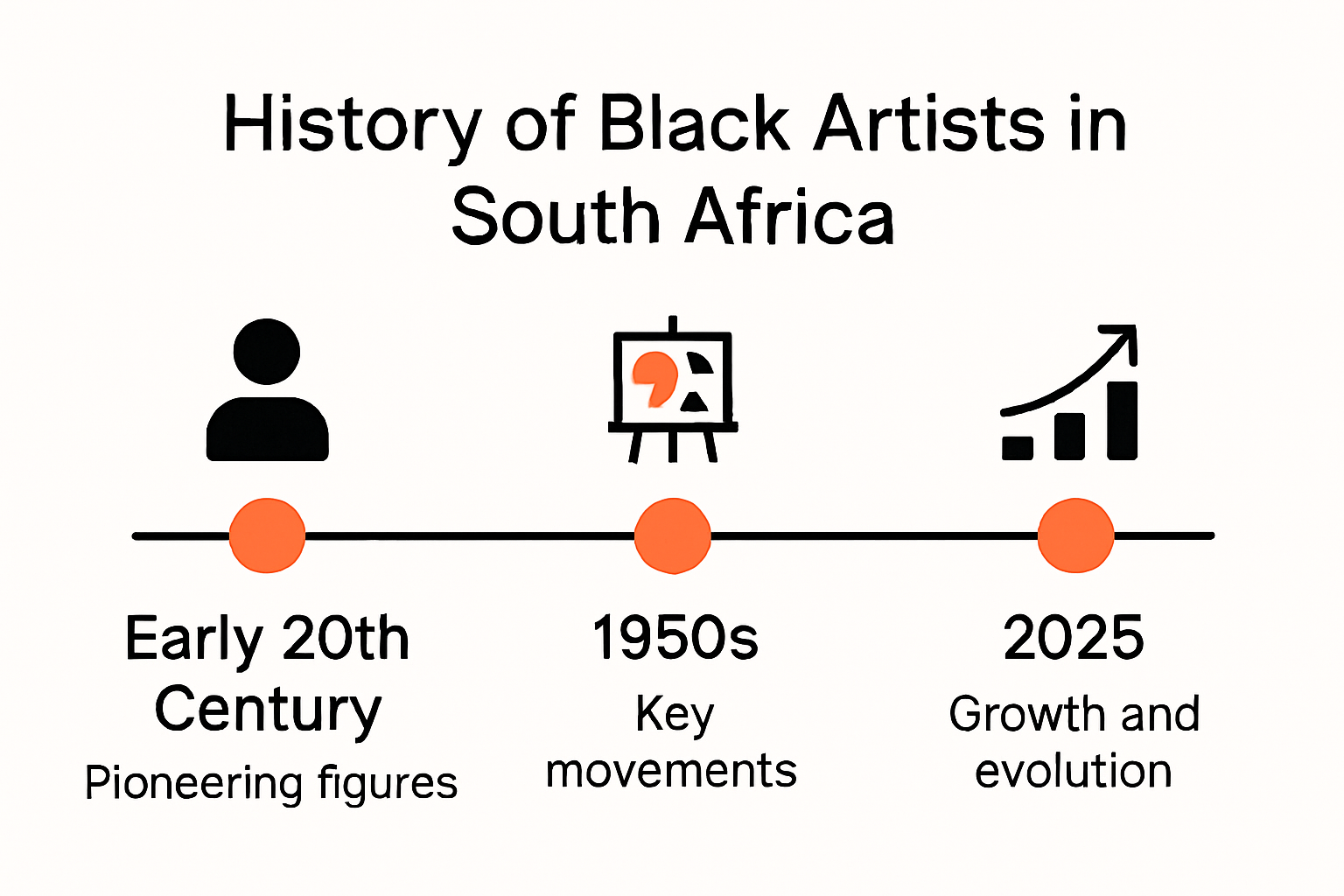
Timeline of Black artists in South African art history

Influential Black Artists in South Africa

South African art has been profoundly shaped by extraordinary Black artists who have transformed visual narratives and challenged historical oppression through their creative expressions. These artists not only capture the complex social landscapes of their time but also redefine artistic representation and cultural identity.

Pioneers of Visual Resistance

Zanele Muholi stands at the forefront of visual activism, challenging societal norms through powerful photographic documentation. According to Time Magazine, Muholi has spent nearly two decades documenting the lives of Black LGBTQIA+ individuals in South African townships, creating an essential visual archive that resists marginalization. Their work transcends traditional photography, serving as a critical form of social documentation and resistance.

Dumile Feni represents another pivotal figure in south-african art history. Known for his profound drawings and sculptures, Feni’s work eloquently communicated the brutal realities of apartheid. His artistic legacy demonstrates how Black artists transformed personal suffering into powerful artistic statements that challenged systemic oppression.

Contemporary Artistic Innovators

Esther Mahlangu exemplifies the continuation of cultural artistic traditions while simultaneously pushing contemporary boundaries. As reported by Associated Press, her work not only preserves Ndebele cultural painting techniques but also transforms them into globally recognized art forms. Her internationally commissioned BMW artwork represents a remarkable intersection of traditional craft and modern artistic expression.

These artists share a common thread: their ability to use art as a medium for social commentary, cultural preservation, and personal empowerment. They challenge viewers to reconsider established narratives about identity, struggle, and resilience. Their work goes beyond aesthetic appreciation, serving as powerful historical documents that capture the nuanced experiences of Black south-africans during and after apartheid.

The diversity of their artistic approaches underscores the richness of Black artistic expression in South Africa. From Muholi’s photographic activism to Mahlangu’s traditional painting techniques, these artists demonstrate that art is never just about visual representation but about telling stories that have been historically silenced.

Collectors and art enthusiasts recognize the profound significance of these artists. Their works are not merely decorative pieces but critical cultural artifacts that document social transformation, challenge historical narratives, and celebrate the complexity of Black south-african experiences.

As we move into 2025, the legacy of these influential Black artists continues to inspire new generations of creatives who understand art’s potential as a transformative social tool. Their contributions ensure that south-african art remains a dynamic, evolving expression of cultural identity and resistance.

To provide a concise overview, the following table highlights key influential Black South African artists and their notable contributions:

Artist Art Form Notable Contribution
Zanele Muholi Photography Visual activism, LGBTQIA+ documentation, social resistance
Dumile Feni Drawing, Sculpture Expressing realities of apartheid, resistance through art
Esther Mahlangu Painting Preserving Ndebele tradition, innovating global commissions
Mary Sibande Sculpture, Visual Art Exploring identity and postcolonial narratives
iQhiya Collective Mixed Media Collaborative practice, amplifying marginalised voices

The contemporary south-african art scene is experiencing a dynamic transformation, with Black artists pushing boundaries and redefining artistic expression through innovative approaches that challenge traditional narratives and institutional constraints.

Collective Movements and Collaborative Strategies

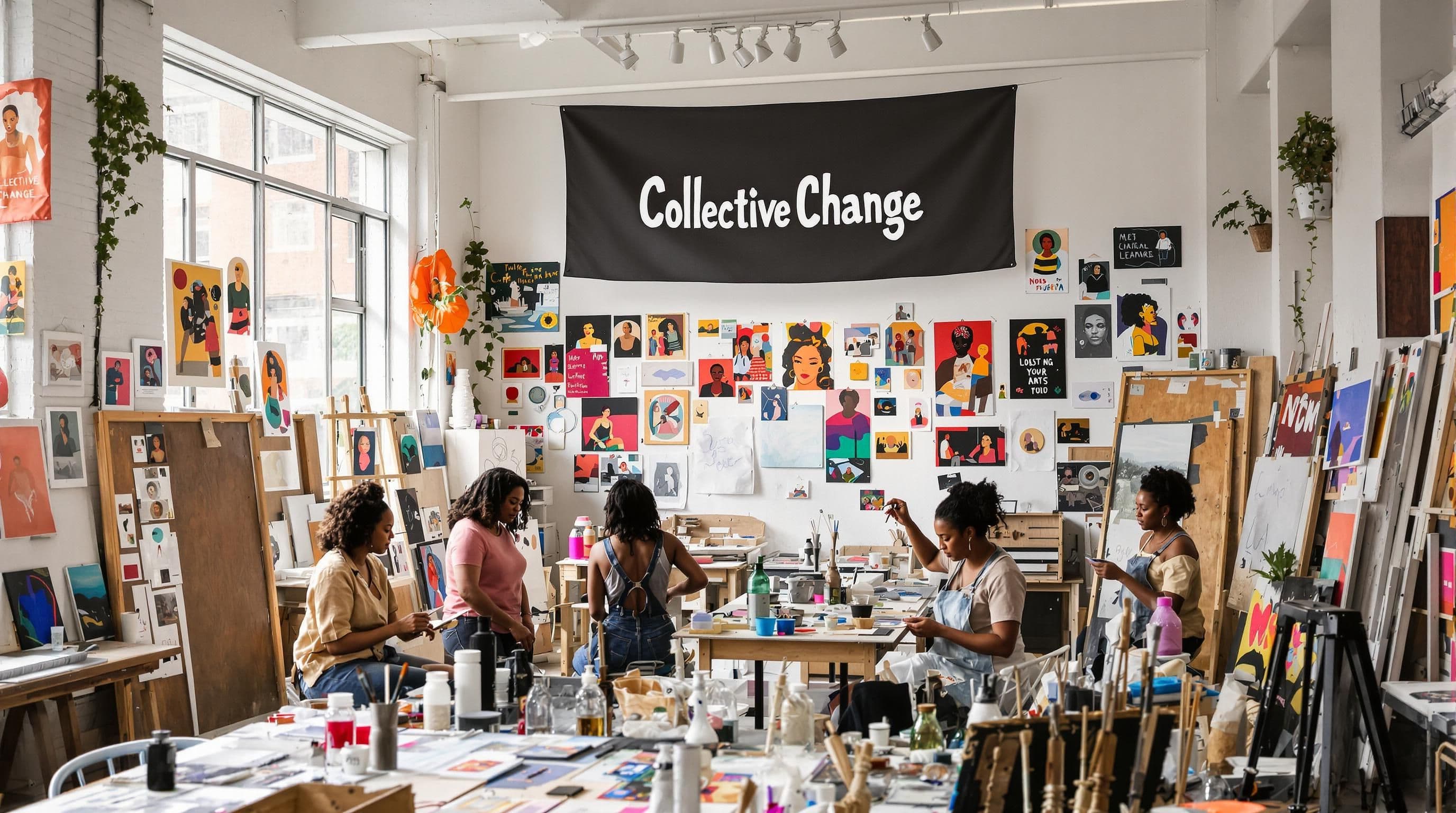
The iQhiya Collective, formed in 2015, represents a powerful emerging trend of collaborative artistic engagement. This network of young Black women artists demonstrates a strategic approach to art-making that transcends individual practice. By working across disciplines including performance art, video, photography, and sculpture, they create collaborative platforms that amplify marginalized voices and contest institutional barriers.

These collective strategies signify more than artistic collaboration. They represent a deliberate political and social intervention, challenging systemic exclusions within the art world. By creating safe spaces for shared conceptual exploration, these collectives redefine how art is created, perceived, and valued.

Black women artists collaborating in creative Johannesburg studio space

Intersectional Identity and Visual Activism

Contemporary Black south-african artists are increasingly employing intersectional approaches that explore complex identities. As documented by research, artists like Mary Sibande create profound visual narratives that critique stereotypical representations and explore postcolonial experiences. Her work exemplifies how south-african artists use visual art as a powerful medium for social commentary and personal storytelling.

Zanele Muholi’s groundbreaking photographic series ‘Somnyama Ngonyama’ further illustrates this trend. Through provocative self-portraits, Muholi challenges oppressive beauty standards and reimagines Black identity. Their work demonstrates how contemporary Black artists are using visual mediums to reclaim narrative agency and challenge historical misrepresentations.

Technological Integration and Global Dialogue

Emerging trends also reveal significant technological integration in artistic practices. Digital platforms, social media, and global connectivity are enabling south-african Black artists to reach international audiences, share their narratives, and participate in global conversations about identity, representation, and social justice.

This technological engagement allows for unprecedented artistic dialogue, breaking down geographical and institutional barriers. Artists can now showcase their work, connect with global audiences, and participate in international artistic discourse with unprecedented ease and immediacy.

The emerging trends in south-african Black art are characterized by collective resistance, intersectional storytelling, and technological empowerment. These artists are not merely creating art but constructing powerful narratives of identity, resilience, and transformation.

Collectors and art enthusiasts are increasingly recognizing the profound significance of these emerging artistic practices. The works emerging from this new generation of Black south-african artists are more than aesthetic objects. They are complex cultural artifacts that document social experiences, challenge historical narratives, and imagine alternative futures.

As we move towards 2025, these trends suggest a vibrant, dynamic future for south-african art. The continuous evolution of artistic expression promises ongoing innovation, critical engagement, and powerful storytelling that centers Black experiences and perspectives.

Collecting South African Black Art: Tips and Resources

Collecting Black south-african art requires nuanced understanding, strategic approach, and deep respect for the cultural significance embedded within each artwork. As the art market evolves, collectors must develop sophisticated strategies that go beyond mere aesthetic appreciation.

Understanding Artwork Provenance and Cultural Context

According to Iziko Museums, understanding the cultural context is fundamental when collecting African art. Their extensive collection of approximately 3,000 works demonstrates the importance of comprehending the historical and social narratives behind each piece. Collectors should invest time in researching the artist’s background, the artwork’s historical context, and the specific cultural traditions that influence its creation.

When evaluating potential acquisitions, consider more than visual appeal. Examine the artwork’s documentation, artist’s reputation, exhibition history, and potential future value. Authenticity certificates, provenance records, and documentation from reputable institutions can significantly enhance an artwork’s collectibility and investment potential.

Strategic Acquisition and Market Insights

The Northeast Louisiana Delta African-American Heritage Museum recommends building relationships within the art community as a critical strategy for collectors. This involves engaging with Black-owned galleries, attending exhibitions, and connecting with artists and fellow collectors.

Develop a comprehensive understanding of the south-african art market by:

  • Attending art fairs and exhibitions specializing in contemporary Black art
  • Following emerging artists and their career trajectories
  • Understanding pricing trends and market dynamics
  • Networking with curators, gallery owners, and established collectors

Institutional Resources and Educational Approaches

The Wits Art Museum offers valuable insights into collecting south-african art through their comprehensive collections. Their approach emphasizes the importance of continuous learning and engagement with institutional archives and exhibitions.

Collectors should leverage institutional resources such as:

  • Museum archives and collection catalogs
  • Academic publications on south-african art history
  • Curator-led talks and artist conversations
  • Online databases and research platforms

Effective collecting is not merely about acquisition but about creating a meaningful dialogue with artistic heritage. Each artwork represents a complex narrative of cultural expression, historical struggle, and creative resilience.

As the south-african art market continues to evolve, collectors must remain adaptable, informed, and committed to supporting and understanding Black artistic expression. The most successful collectors approach their collection as an ongoing conversation with artists, their communities, and the broader cultural landscape.

By 2025, the landscape of Black south-african art collecting will likely become increasingly sophisticated, with greater emphasis on digital platforms, global connectivity, and nuanced understanding of artistic contexts. Collectors who invest in education, build genuine relationships, and approach their acquisitions with respect and curiosity will be best positioned to build meaningful and valuable collections.

To summarise key actions for aspiring and established collectors, the following table organises practical tips and resources mentioned in this section:

Step or Resource Purpose / Benefit
Research artist background and cultural context Appreciate artwork’s deeper meaning and relevance
Review provenance and authenticity documentation Ensure value, authenticity, and future collectibility
Engage with Black-owned galleries and exhibitions Build relationships and support local art communities
Attend art fairs and follow emerging artists Identify trends and future investment opportunities
Utilise museum archives and academic publications Gain institutional knowledge and historical context
Attend curator talks and artist events Deepen understanding through expert perspectives
Monitor pricing trends and network with collectors Make informed market decisions and acquisitions

Incorporating Local Art into Interior Spaces

Incorporating Black south-african art into interior spaces transcends mere decoration. It represents a profound cultural dialogue that transforms living environments into meaningful narratives of identity, resistance, and artistic expression.

Cultural Storytelling through Art Placement

According to Financial Times, African modernist artists are experiencing unprecedented global recognition. This shift provides interior designers and homeowners with opportunities to curate spaces that celebrate south-african artistic heritage. Strategic art placement can create powerful visual narratives that honor cultural complexity and artistic innovation.

When selecting artworks, consider pieces that communicate more than aesthetic appeal. Look for works that represent different artistic movements, generational perspectives, and regional diversity. A carefully curated collection can transform a room from a simple living space into a dynamic cultural statement.

As reported by Insurance Chat, the African art market has seen remarkable growth. Sales surged by 46% between 2013 and 2023, with contemporary African art emerging as a lucrative investment opportunity. This trend suggests that incorporating local art is not just an aesthetic choice but a potentially valuable financial decision.

Consider these strategies when integrating south-african art into interior spaces:

  • Mix different mediums like paintings, sculptures, and textile art
  • Create focal points that draw attention to specific pieces
  • Balance contemporary and traditional artistic styles
  • Consider lighting that enhances artwork presentation

Design Philosophy and Authenticity

From Gauteng News, the concept of Afrothencity emphasizes celebrating authentic African identity through design. This philosophy extends beyond fashion into interior spaces, encouraging designers and homeowners to use indigenous materials, traditional craftsmanship, and storytelling elements.

Authentic incorporation means more than hanging an artwork. It involves understanding the context, respecting the artist’s narrative, and creating an environment that allows the art to breathe and communicate. Consider complementary design elements like traditional textiles, handcrafted furniture, or color palettes inspired by south-african landscapes.

Successful art integration requires thoughtful curation. Each artwork should feel intentionally placed, creating conversations between different pieces and the surrounding environment. Consider the emotional and cultural resonance of each piece, not just its visual compatibility.

By 2025, interior design is increasingly about creating spaces that tell stories. Black south-african art offers a rich, complex narrative of resilience, creativity, and cultural transformation. Whether in residential spaces, corporate environments, or public institutions, these artworks serve as powerful cultural ambassadors.

For collectors and design enthusiasts, incorporating south-african art is an opportunity to support living artists, preserve cultural heritage, and create spaces that are simultaneously beautiful, meaningful, and transformative. The most compelling interiors are those that invite dialogue, challenge perspectives, and celebrate the profound depth of south-african artistic expression.

Frequently Asked Questions

Emerging trends include collective movements that challenge mainstream narratives, intersectional identity exploration, and the integration of technology to facilitate global dialogue.

Who are some influential Black artists in South Africa?

Notable Black artists include Zanele Muholi, known for their visual activism in photography; Dumile Feni, recognized for depicting apartheid realities; Esther Mahlangu, who merges traditional Ndebele techniques with contemporary art; and Mary Sibande, who explores identity and postcolonial themes through sculpture.

How can I effectively collect South African Black art?

Successful collecting involves understanding artwork provenance, building relationships within the art community, attending galleries and exhibitions, and staying informed on market trends and artists’ trajectories.

What is the significance of incorporating Black South African art into interior spaces?

Integrating Black South African art into interiors enhances cultural storytelling, creates meaningful visual narratives, and can also serve as a valuable investment as the contemporary African art market continues to grow.

Bring the Story of Black South African Art to Your Space

For many collectors and design lovers, the biggest challenge is finding authentic works by influential Black artists that truly reflect the heritage, innovation, and bold narratives discussed in our guide. Perhaps you have been searching for meaningful pieces that add both cultural value and investment strength to your collection or interiors. Maybe you want to support living artists and become part of the growing movement of empowered collecting.

https://art-online.co.za

Now is the perfect time to take action. With Art Online, South Africa’s largest online art gallery, you can access a curated selection of works from some of the country’s most renowned Black artists and exciting contemporary voices. Discover how easy it is to build a collection that combines authentic storytelling, strategic investment, and visual impact. Visit Art Online today to experience the next generation of South African art for yourself. Start your journey and let each piece become a lasting testament to identity, resilience, and transformation.

Posted on Leave a comment

Famous African Art Pieces for Collectors and Decorators 2025

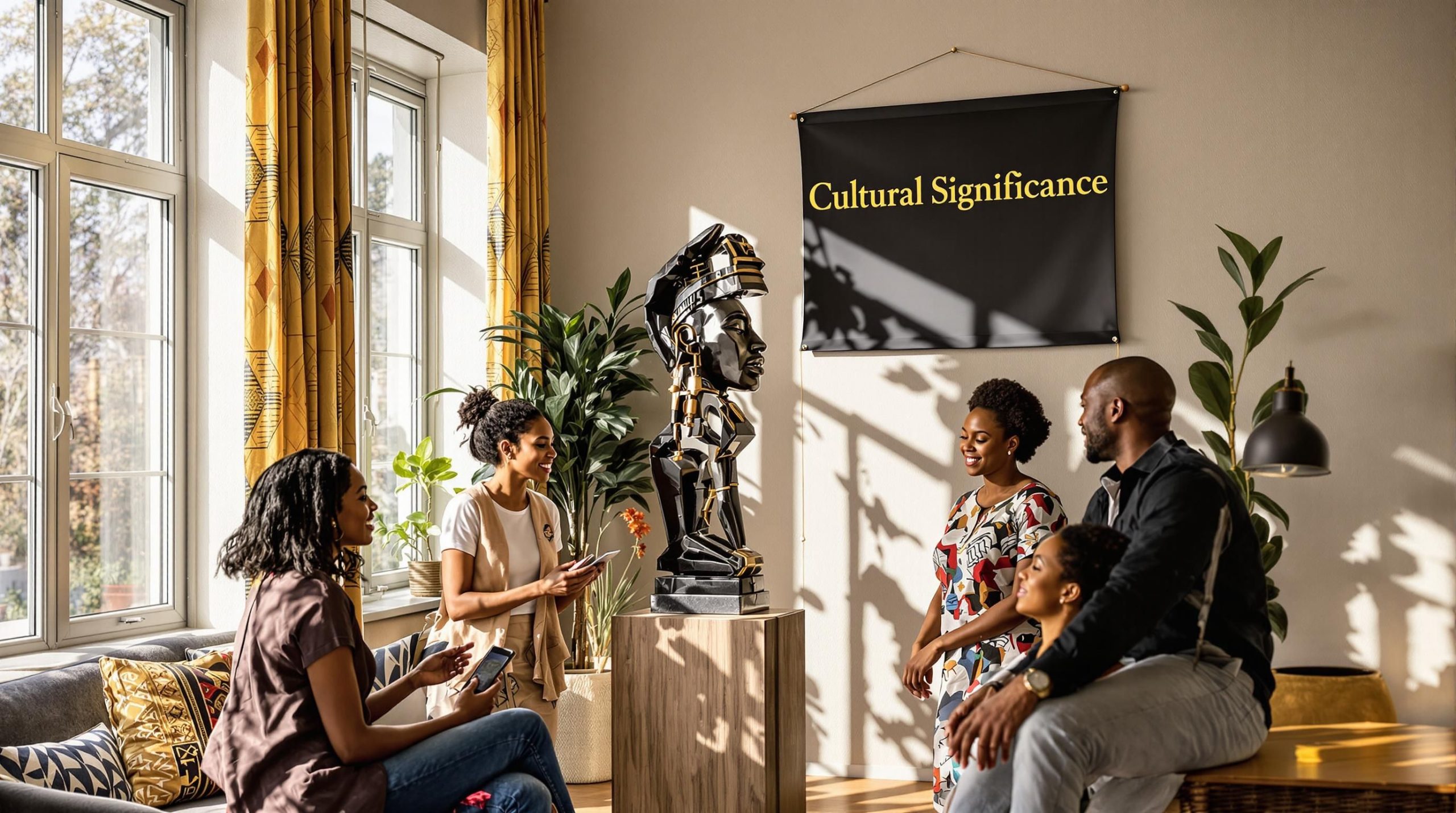
Modern room with people admiring African sculpture, cultural appreciation evident

African art is not just decorative, it tells stories that reach back thousands of years and shape how the world sees the continent. Most people focus on the beauty of the pieces, the bold colours and striking forms. But the real shocker is that some African artworks have fetched over R20 million at international auctions, proving collectors value their deep cultural history even more than their looks. There is much more to these masterpieces than meets the eye.

Table of Contents

Quick Summary

Takeaway Explanation
Understand the significance of African art African art tells deep cultural stories and reflects complex historical experiences and artistic innovations.
Incorporate art thoughtfully into decor Strategically place and complement African art with design elements that respect its cultural value and enhance its visual impact.
Focus on provenance and authenticity Verify each artwork’s origin and cultural significance to ensure an authentic African art collection.
Practice ethical acquisition Support artists and communities by purchasing art ethically, avoiding exploitative practices related to colonialism.
Commit to preservation and engagement Collectors should actively engage with the cultural context and scholarly research related to their art pieces to ensure their preservation.

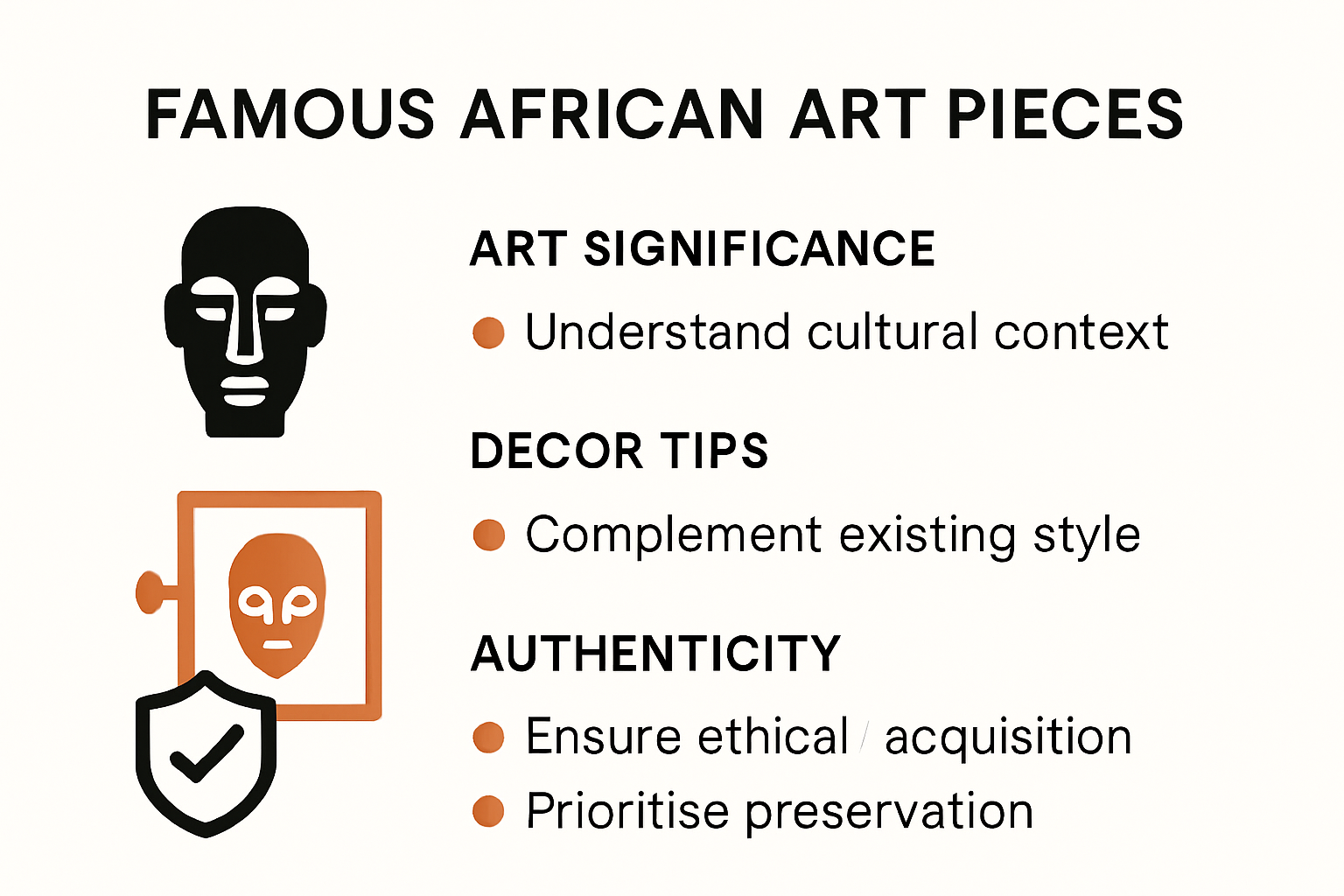
Summary infographic on famous African art pieces for collectors and decorators


African art represents a profound cultural narrative that transcends mere visual representation, embodying centuries of historical significance and artistic innovation. The continent’s artistic heritage encompasses diverse mediums that reflect complex social structures, spiritual beliefs, and extraordinary craftsmanship.

Ancient Masterpieces of African Sculpture

Some of the most remarkable famous African art pieces emerge from ancient sculptural traditions that have captured global attention. The Benin Bronzes, created by the Edo people of Nigeria, stand as extraordinary examples of metalwork that demonstrate extraordinary technical skill and cultural sophistication. According to research from the British Museum, these intricate metal plaques and sculptures represent royal court scenes, warriors, and important historical events with remarkable detail and precision.

The Benin ivory mask represents another pinnacle of African artistic achievement. Crafted during the height of the Benin Kingdom, this delicate yet powerful artwork illustrates the extraordinary craftsmanship of African artisans. Its intricate details and symbolic representations reveal complex social hierarchies and artistic techniques that were generations ahead of their time.

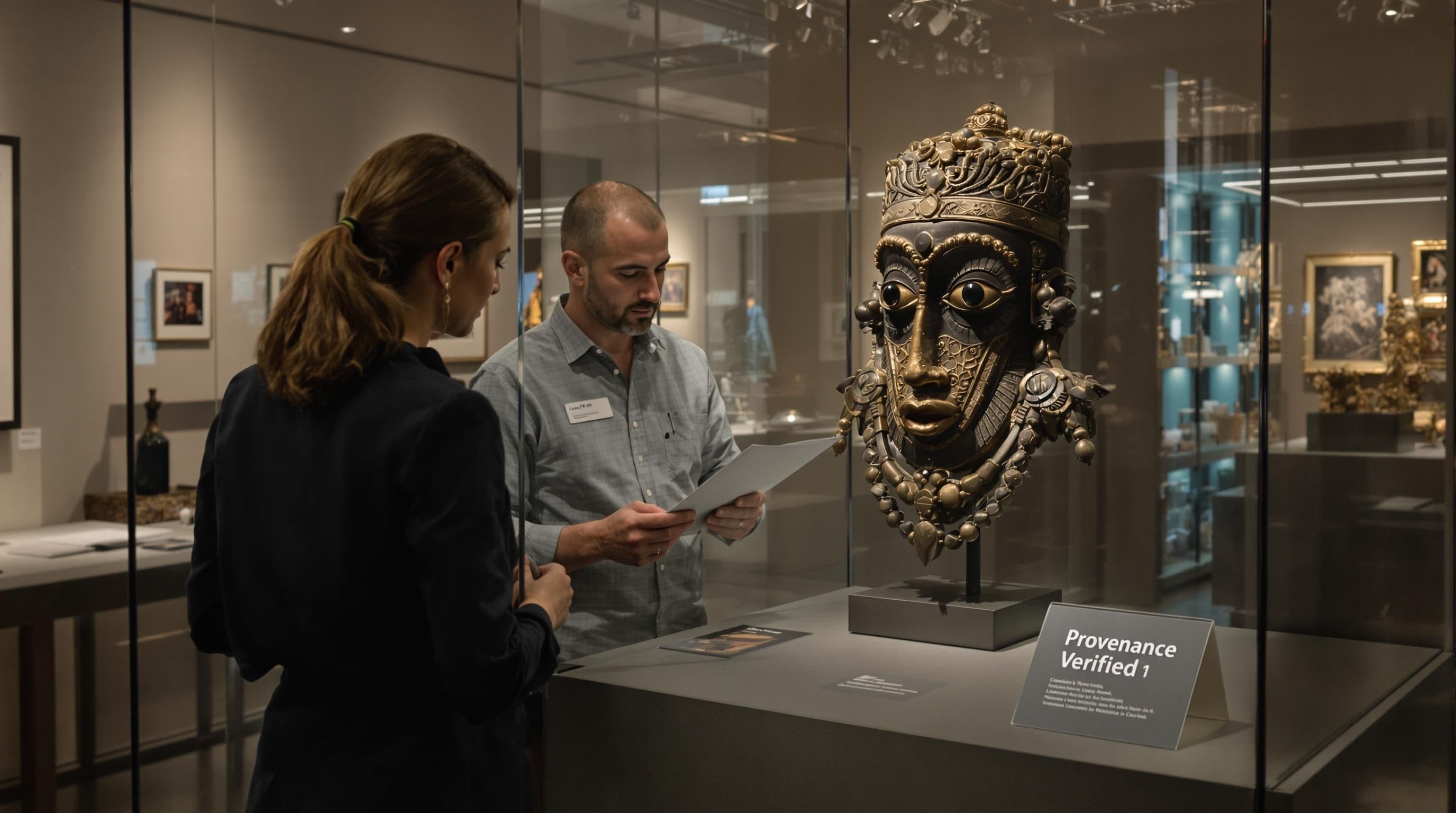
Experts authenticate and study Benin Bronze sculpture with provenance documents

Ritual and Symbolic Art Forms

African art extends far beyond aesthetic beauty, serving profound cultural and spiritual purposes. Ritual masks, wooden sculptures, and textiles are not merely decorative objects but powerful communication tools that connect communities with their ancestral heritage. Encyclopædia Britannica highlights that these artworks often embody spiritual concepts, representing communication between human and supernatural realms.

Traditional sculptures from regions like the Congo, Nigeria, and Ethiopia demonstrate extraordinary woodcarving techniques. These pieces frequently represent ancestral spirits, community leaders, and mythological figures, each carrying deep symbolic meaning. Collectors and decorators appreciate these artworks not just for their visual appeal but for their profound cultural narratives.

When selecting famous African art pieces, discerning collectors understand that each artwork tells a story far more complex than its physical form suggests. These masterpieces represent generations of artistic knowledge, cultural preservation, and extraordinary human creativity. From intricate bronze castings to spiritually charged wooden sculptures, African art continues to captivate global audiences with its depth, symbolism, and unparalleled craftsmanship.

To help readers compare notable ancient African artworks mentioned, the following table summarizes their origins, materials, and significance.

Artwork Origin Material Key Significance
Benin Bronzes Edo people, Nigeria Bronze/Brass Royal court scenes, technical mastery, historic events
Benin Ivory Mask Benin Kingdom Ivory Symbolic craftsmanship, social hierarchy, artistry
Ritual Masks Various (West, Central Africa) Wood/Textile Spiritual communication, ritual purposes
Wooden Sculptures Congo, Nigeria, Ethiopia Wood Ancestral spirits, community leaders, mythological figures

Influential Artists and Their Masterpieces

African art has been profoundly shaped by extraordinary artists who have transformed traditional techniques into powerful contemporary expressions. These influential creators have not only preserved cultural heritage but also challenged global perceptions of African artistic traditions.

Modern Pioneers of African Visual Arts

El Anatsui, a renowned Ghanaian artist, stands as a transformative figure in contemporary African art. His massive textile-like installations made from discarded metal bottle caps have revolutionized sculptural practices. According to the Metropolitan Museum of Art, Anatsui’s work represents a profound commentary on consumption, globalization, and the interconnectedness of human experiences.

Anotherartist of significant impact is William Kentridge, a south-african visual artist known for his distinctive charcoal drawings and animated films. The Museum of Modern Art highlights Kentridge’s unique approach of creating narrative works that explore themes of colonialism, social justice, and historical memory through powerful visual storytelling.

Sculptors and Visual Storytellers

Nigerian artist Ben Enwonwu represents another pivotal figure in African artistic evolution. His sculpture and painting work bridged traditional African artistic practices with modernist techniques. Research from the Tate Modern demonstrates how Enwonwu challenged colonial artistic paradigms, creating works that celebrated African cultural identity while engaging with global artistic movements.

Female artists have also played crucial roles in expanding the boundaries of African art. Artists like Wangechi Mutu from Kenya have gained international recognition for their innovative mixed media works that explore themes of gender, colonialism, and identity. Her intricate collages and sculptures challenge traditional representations and offer powerful visual narratives about contemporary African experiences.

These artists represent more than individual creative talents they are cultural ambassadors who have transformed global understanding of African artistic expression. Their masterpieces are not merely aesthetic objects but profound statements about history, identity, and human experience. Collectors and decorators who appreciate these works understand that they are acquiring more than art they are preserving complex cultural dialogues that transcend geographical and temporal boundaries.

The diversity of styles techniques and conceptual approaches demonstrates the rich complexity of African artistic traditions. From intricate sculptural works to revolutionary mixed media installations these artists continue to push creative boundaries challenging viewers to reconsider their perceptions of African art and cultural expression.

To provide an overview of the influential contemporary African artists and their core artistic contributions, see the table below.

Artist Country Medium/Style Major Themes
El Anatsui Ghana Assemblage (metal bottle caps) Consumption, globalization, interconnectedness
William Kentridge South Africa Charcoal drawing, animation Colonialism, social justice, historical memory
Ben Enwonwu Nigeria Sculpture, painting Cultural identity, modernism vs. tradition
Wangechi Mutu Kenya Mixed media, collage, sculpture Gender, colonialism, contemporary African identity

How to Incorporate African Art in Decor

Incorporating African art into home decor requires a thoughtful approach that respects the cultural significance and artistic integrity of each piece. Successful integration goes beyond mere decoration it is about creating meaningful visual narratives that celebrate African artistic heritage.

Strategic Placement and Composition

Research from interior design experts suggests that displaying African art requires careful consideration of space and context. Large statement pieces like El Anatsui’s metal tapestries or intricate wooden sculptures can serve as dramatic focal points in living rooms or entryways. Wall-mounted sculptures and paintings work exceptionally well in spaces with neutral backgrounds, allowing the artwork’s rich textures and colors to stand out.

For collectors seeking to create cohesive displays, consider creating gallery walls that mix different African art mediums. Combine paintings, textile works, masks, and smaller sculptural pieces to develop a dynamic visual composition that tells a comprehensive story of African artistic traditions.

Complementing Design Aesthetics

Design specialists recommend integrating African art through thoughtful material selection and color coordination. Natural materials like wooden furniture, woven textiles, and handcrafted ceramics can create a harmonious backdrop for African artworks. Mud cloths, kente textiles, and traditional basketry can be incorporated as decorative elements that complement the art pieces.

Color plays a crucial role in successful integration. Many African artworks feature vibrant, earthy tones that can inspire broader room color schemes. Select furniture and accessories that echo the artwork’s color palette to create a unified design language. Neutral tones like beige, terracotta, and deep browns work particularly well with most African art styles.

Contextual Display and Preservation

Beyond aesthetic considerations, proper display and preservation are critical for maintaining the value and integrity of African art pieces. Use appropriate lighting that highlights the artwork’s details without causing damage. Avoid direct sunlight and maintain consistent humidity levels to prevent deterioration. Professional art mounting and framing can protect delicate pieces while enhancing their visual impact.

For collectors and decorators, African art is more than a decorative element it represents a connection to rich cultural narratives and artistic traditions. Each piece carries historical significance, telling stories of community, spirituality, and human experience. By approaching African art with respect, understanding, and thoughtful design integration, decorators can create spaces that are not just visually stunning but also culturally meaningful.

Remember that the goal is not to treat African art as an exotic accessory, but to honor its depth, complexity, and artistic excellence. Thoughtful curation transforms these artworks from mere decorative objects into powerful statements of cultural appreciation and artistic dialogue.

Curating an Authentic African Art Collection

Building an authentic African art collection requires more than financial investment it demands deep respect, comprehensive research, and a nuanced understanding of cultural contexts. Collectors must approach acquisition as a scholarly and ethical journey that goes beyond mere aesthetic appreciation.

Understanding Provenance and Authenticity

The Metropolitan Museum of Art emphasizes the critical importance of documenting an artwork’s historical journey. Authentic African art collections are built through meticulous research that traces each piece’s origin, cultural significance, and historical narrative. This process involves examining not just the artwork itself, but its broader cultural and historical context.

Key considerations for establishing authenticity include:

  • Detailed documentation of the artwork’s creation
  • Verification of traditional crafting techniques
  • Understanding the specific cultural and tribal context
  • Consultation with cultural experts and historians

Ethical Acquisition and Cultural Respect

Research published in African Arts highlights the paramount importance of ethical acquisition practices. Modern collectors must move beyond traditional collection models that often involved exploitative colonial practices. This means prioritizing purchases from legitimate sources that directly support contemporary African artists and communities.

Ethical collection strategies include:

  • Purchasing directly from artists or authorized galleries
  • Ensuring fair compensation for artistic work
  • Supporting contemporary African artistic production
  • Respecting intellectual and cultural property rights

Preservation and Scholarly Engagement

An authentic African art collection is not a static assemblage but a dynamic cultural dialogue. Collectors should view their role as custodians of cultural heritage, committed to understanding and preserving the deeper meanings embedded in each artwork. This involves ongoing education, engagement with scholarly research, and creating platforms that promote genuine cultural understanding.

Preservation techniques specific to African art require specialized knowledge. Different materials like wood, metal, textile, and clay demand unique conservation approaches. Temperature control, humidity management, and careful handling are crucial to maintaining the integrity of these delicate and historically significant pieces.

True collection excellence transcends mere possession. It represents a commitment to cultural dialogue, artistic appreciation, and respectful representation. By approaching African art with intellectual curiosity, ethical consideration, and profound respect, collectors can transform their personal collections into powerful narratives of cultural exchange and artistic excellence.

Remember that each artwork tells a story far beyond its visual attributes. It carries the memories, traditions, and creative spirit of its creators a living testament to the rich and diverse artistic traditions of the African continent.

Frequently Asked Questions

What are some of the most famous African art pieces?

African art includes iconic works like the Benin Bronzes, Benin Ivory Mask, and various ritual masks and wooden sculptures, each carrying deep cultural significance and showcasing extraordinary craftsmanship.

How can I incorporate African art into my home decor?

Incorporate African art by strategically placing pieces as focal points, using complementary design aesthetics with natural materials, and ensuring proper contextual display that respects the artwork’s cultural origins.

How do I ensure the authenticity of African art before purchasing?

To ensure authenticity, research the artwork’s provenance, consult with cultural experts, and verify the indigenous crafting techniques used in its creation to confirm its cultural and historical significance.

What ethical considerations should I keep in mind when collecting African art?

Collectors should prioritize ethical acquisition by purchasing directly from artists or authorized galleries, ensuring fair compensation, and respecting the intellectual property rights of the cultures represented in the artworks.

Transform Your Passion for African Art into a Timeless Collection

Are you captivated by the rich history and extraordinary stories behind famous African art pieces? Many collectors and decorators dream of owning authentic artworks that go beyond decoration and become part of a living cultural legacy. But finding genuine masterpieces and ensuring their ethical acquisition can be overwhelming. When provenance, authenticity, and thoughtful display matter, where do you turn for trustworthy guidance and exceptional art?

https://art-online.co.za

Experience the confidence of collecting with South Africa’s largest online art gallery. Discover a curated selection of works from celebrated local artists who honour traditional craft and push creative boundaries. Visit Art Online today to access exclusive pieces available right now. Take this step to build a collection that reflects your values and love for African heritage. Elevate your space with art that tells a story and secure your investment before these sought-after works move into new hands. Start your journey to an authentic collection with Art Online.

Posted on Leave a comment

What Is Landscape Art? A South African Perspective for 2025

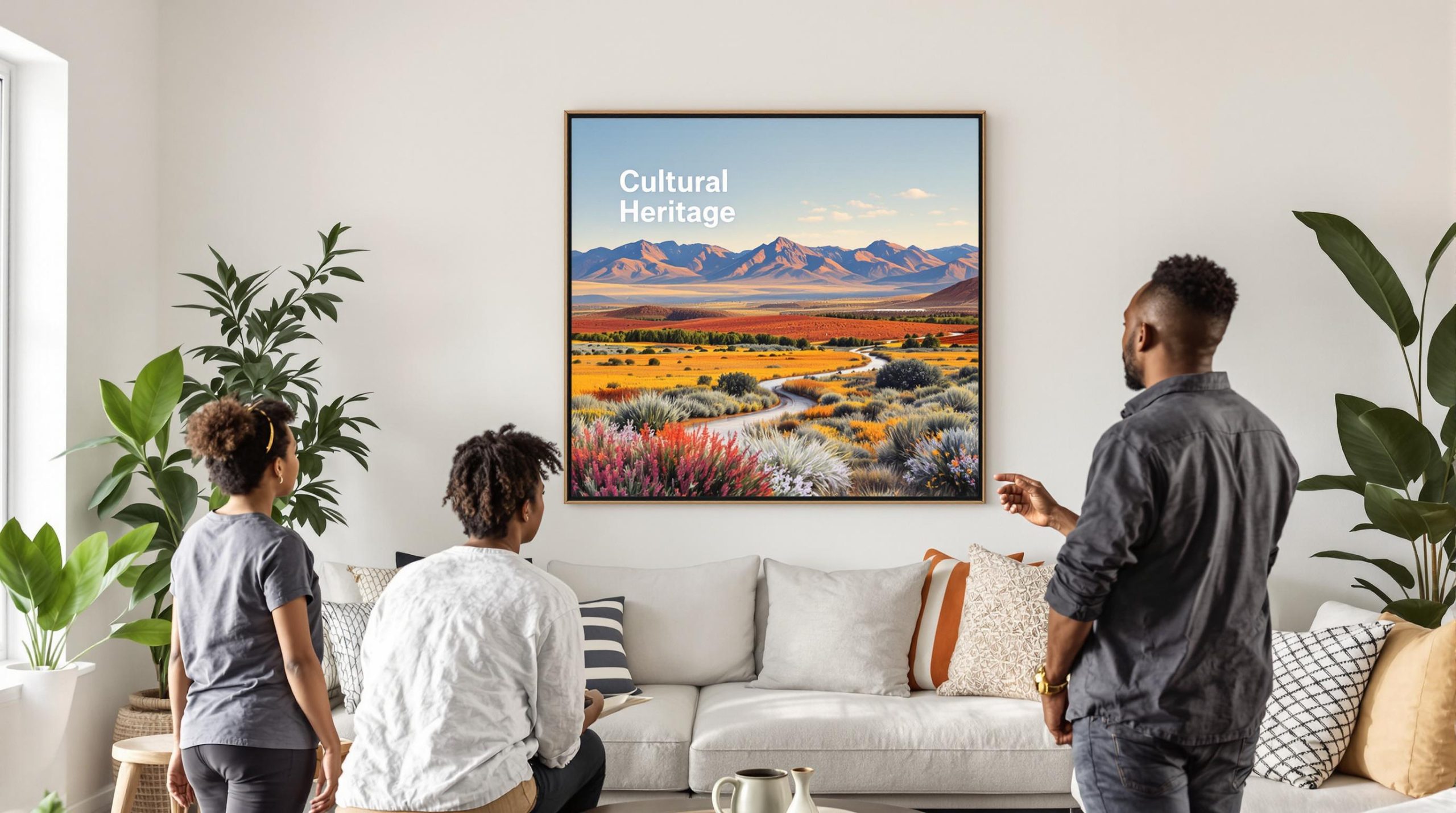
People admiring South African landscape art in a sunlit modern home

Landscape art has become more than just pretty scenery on a wall. In South Africa, it has grown into a powerful symbol of culture and heritage. Here is something unexpected. More than 70 percent of South Africans believe landscape artworks influence how they feel at home or work. This goes beyond simple decoration. These artworks hold stories and emotions that connect people to the land and to each other in ways most people never consider.

Table of Contents

Quick Summary

Takeaway Explanation
Landscape art is culturally significant. It serves as a medium for expressing identity, heritage, and environmental narratives, particularly in South Africa.
Art enhances interior spaces’ emotional impact. Landscape artworks can evoke specific feelings, promoting tranquility or energising environments, depending on their themes and colours.
Color selection influences emotional resonance. Selecting artwork with the right colour palette can significantly affect the mood and perception of a space.
Placement should consider spatial dynamics. Thoughtful placement of landscape art is vital to ensure it harmonises with existing architectural elements and enhances the overall design.
Art selection reflects personal narrative and vision. Choosing the right landscape piece should resonate with personal experiences and their stories, enriching the collector’s connection to the artwork.

Understanding the Basics of Landscape Art

Landscape art represents a profound visual exploration of natural environments, capturing the essence of geographical spaces through artistic interpretation. At its core, landscape art transcends mere visual representation, transforming natural scenes into powerful emotional and cultural narratives.

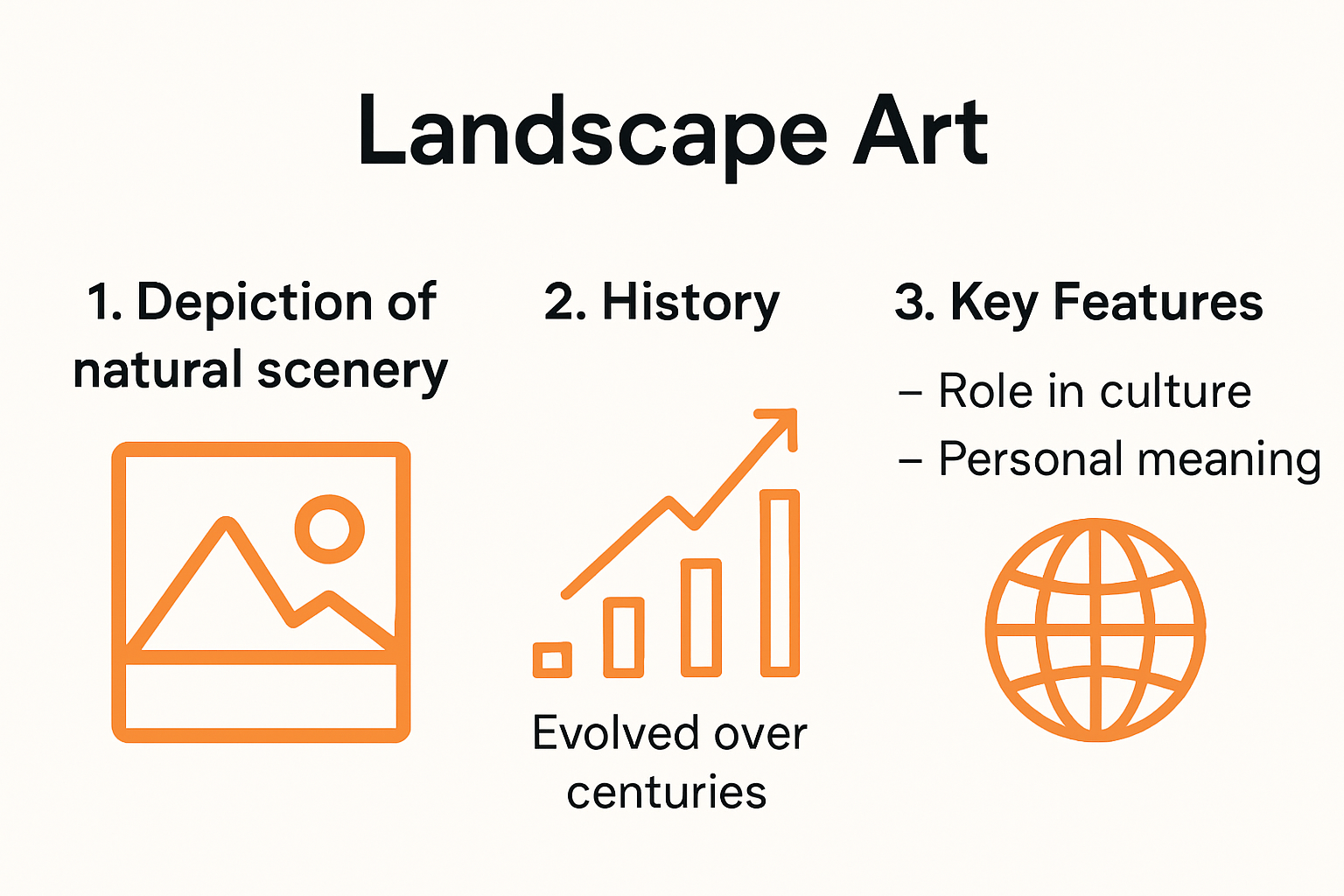
Infographic showing what is landscape art and its evolution

The Fundamental Definition of Landscape Art

According to Tate Gallery, landscape art is a genre primarily focused on depicting natural scenery, including mountains, forests, rivers, and expansive terrains. In the South African context, this artistic tradition goes beyond simple geographical documentation, serving as a powerful medium for cultural expression and environmental storytelling.


Artists engaging in landscape art do not merely reproduce external scenes but interpret the intricate relationships between human experiences and natural environments. The genre allows creators to communicate complex emotional landscapes, reflecting societal perspectives, historical narratives, and personal connections to specific geographical spaces.

Historical Evolution and Artistic Significance

Landscape art has undergone significant transformations throughout artistic history. Initially considered a lesser form of painting, it gradually emerged as a sophisticated and nuanced artistic expression. South African landscape artists have particularly distinguished themselves by using this medium to explore themes of identity, cultural diversity, and environmental narratives.

The evolution of landscape art reflects broader cultural shifts. Early representations often focused on idyllic, romanticized scenes, while contemporary interpretations challenge traditional perspectives, incorporating more complex narratives about land, belonging, and environmental consciousness. Our guide on South African artistic styles provides deeper insights into these fascinating artistic developments.

In the South African context, landscape art becomes a profound tool for understanding national identity. Artists use natural environments not just as visual backdrops but as dynamic canvases that tell stories of geological diversity, cultural heritage, and environmental transformation. From the arid landscapes of the Karoo to the lush coastal regions, each painting becomes a narrative exploring the multifaceted relationship between people and their geographical spaces.

Understanding landscape art requires appreciating its ability to transcend simple visual representation. It is an intricate dialogue between artistic vision, environmental reality, and cultural interpretation, inviting viewers to see beyond the immediate visual scene and engage with deeper, more nuanced narratives about human experience and natural beauty.

To summarise the key shifts and significance of landscape art in South Africa across different historical periods, see the table below:

Period Main Characteristics Notable Artists
Colonial Era Documentation, outsider’s perspective, focus on exoticism Thomas Baines, George French Angas
Modernist Era Geometric forms, deeper cultural narratives, move from colonial lens Hendrik Pierneef
Contemporary Era Cultural commentary, environmental issues, personal histories Willie Bester, Santu Mofokeng, Zwelethu Mthethwa

The Evolution of Landscape Art in South Africa

South African landscape art represents a dynamic and complex journey that reflects the nation’s intricate social, political, and cultural transformations. From early colonial representations to contemporary interpretative works, the evolution of landscape art in South Africa tells a profound story of artistic expression and national identity.

Colonial Perspectives and Early Representations

During the colonial era, landscape art primarily served as a documentation tool for European settlers and explorers. According to the William Humphreys Art Gallery, early landscape paintings often portrayed the African terrain through an outsider’s lens, emphasizing exoticism and geographical curiosity rather than authentic cultural understanding.

Artists like Thomas Baines and George French Angas created meticulous watercolors and sketches that captured the landscape with scientific precision. These works, while aesthetically remarkable, frequently overlooked the indigenous perspectives and cultural significance of the spaces they depicted.

Modernist Transformations and Cultural Narratives

The emergence of modernist approaches dramatically shifted landscape art’s trajectory in South Africa. The University of Pretoria’s South African Modernism Collection highlights how artists like Hendrik Pierneef revolutionized landscape representation. Pierneef’s geometric landscapes, characterized by clean lines and stylized natural forms, symbolized a new way of perceiving the South African terrain—less as a colonial conquest and more as a complex, living environment.

During this period, landscape art began incorporating deeper cultural narratives. Artists started exploring themes of belonging, displacement, and environmental consciousness. The landscape was no longer just a scenic backdrop but a dynamic canvas representing social and political realities.

Contemporary Interpretations and Global Dialogues

Contemporary South African landscape art has evolved into a sophisticated form of cultural commentary. Explore our collection of modern landscape paintings to witness this remarkable transformation. Artists now use landscape representations to challenge historical narratives, address environmental concerns, and explore complex identities.

As noted in the South African Journal of Science, contemporary landscape art models transcend mere visual representation. They serve as critical platforms for discussing ecological changes, social transformations, and the ongoing negotiation of national identity.

Modern South African landscape artists like Willie Bester, Santu Mofokeng, and Zwelethu Mthethwa create works that deconstruct traditional landscape art paradigms. Their paintings integrate personal histories, political commentary, and environmental perspectives, transforming landscape art from a passive descriptive medium into an active form of social dialogue.

The evolution of landscape art in South Africa mirrors the nation’s complex journey—from colonial documentation to modernist reinterpretation, and now to a globally recognized, nuanced artistic expression that speaks to universal human experiences while remaining deeply rooted in local contexts.

How Landscape Art Enhances Interior Spaces

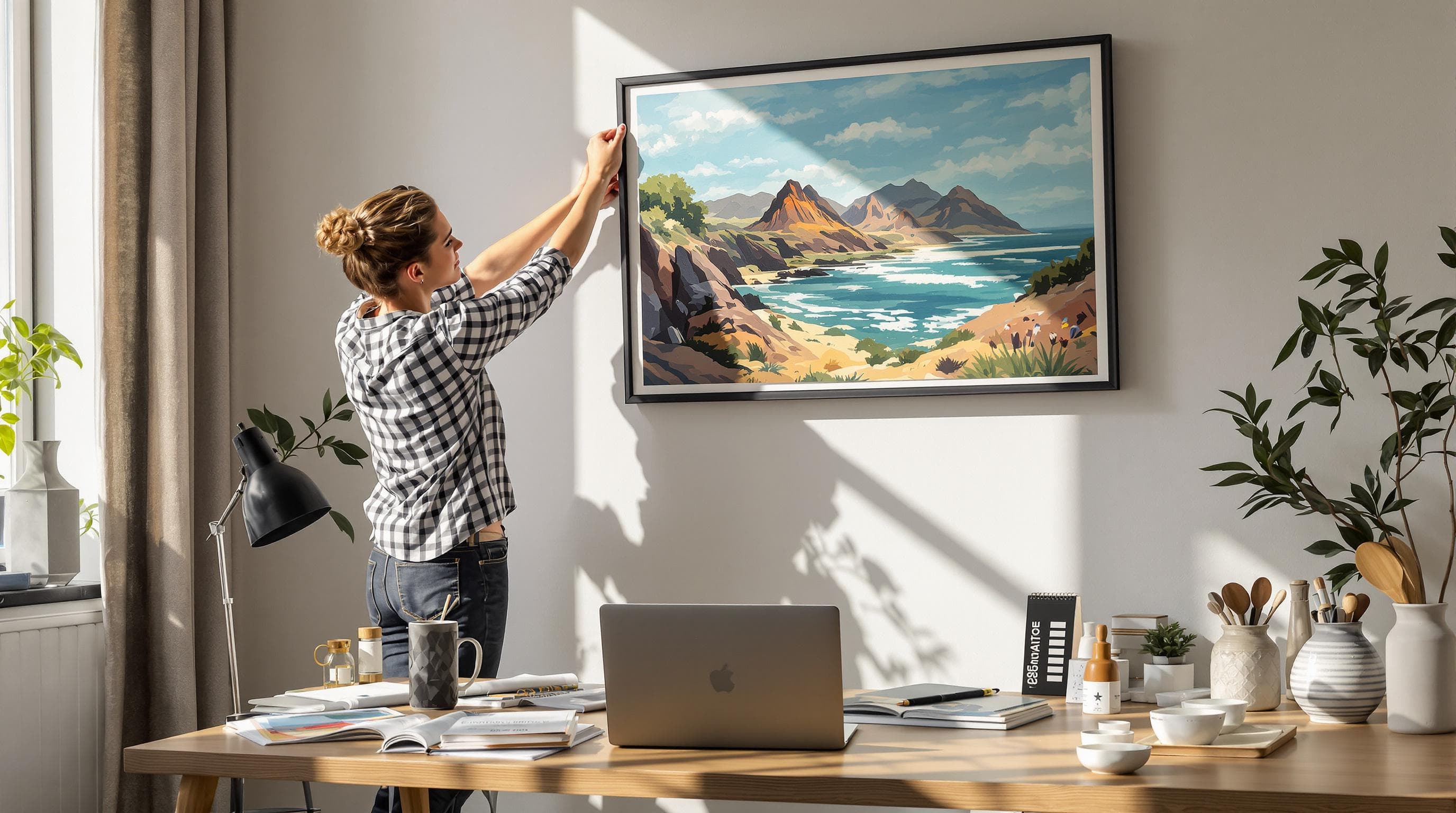
Professional hanging landscape art to enhance emotional impact in workspace

Landscape art transcends traditional decorative elements, transforming interior spaces into dynamic environments that communicate emotion, cultural identity, and aesthetic sophistication. By strategically integrating landscape artworks, interior designers and homeowners can create profound sensory experiences that extend far beyond mere visual decoration.

Psychological and Emotional Impact

Research from the Applied Mathematics and Nonlinear Sciences journal reveals that landscape art significantly influences human psychological responses within interior spaces. These artworks do more than fill wall space they create emotional landscapes that can modulate mood, reduce stress, and generate a sense of connection with natural environments.

Interior spaces featuring landscape art can evoke feelings of tranquility, expansiveness, and contemplation. A carefully selected South African landscape painting might transport viewers to the sweeping plains of the Karoo, the lush coastal regions, or the rugged mountain terrains, creating a powerful sensory narrative within a room. The visual depth and emotional resonance of these artworks can transform mundane spaces into extraordinary experiences.

Cultural Identity and Design Narrative

According to research in design studies, landscape art serves as a critical medium for expressing cultural narratives within interior design. In the South African context, these artworks become more than decorative elements they are profound statements of identity, heritage, and environmental consciousness.

Designers and homeowners can use landscape art to create spaces that tell stories. Explore our curated collection of South African artists to discover artworks that can transform your interior spaces into meaningful cultural expressions. Each painting becomes a conversation piece, inviting viewers to engage with the rich visual history and diverse perspectives embedded in South African artistic traditions.

Strategic Placement and Aesthetic Considerations

The strategic placement of landscape art requires a nuanced understanding of spatial dynamics, color theory, and emotional resonance. Different interior styles demand different approaches to art integration. A minimalist space might benefit from a bold, geometric landscape that provides visual contrast, while a more traditional setting could incorporate soft, impressionistic representations that complement existing design elements.

Consider the emotional tone of the landscape artwork in relation to the room’s function. A vibrant, energetic landscape might invigorate a home office, while a serene, muted scene could create a calming atmosphere in a bedroom or meditation space. The artwork’s color palette, composition, and subject matter should harmonize with the room’s existing design elements, creating a cohesive and meaningful visual experience.

Landscape art in interior spaces is not merely about decoration but about creating environments that breathe, communicate, and inspire. By thoughtfully selecting and integrating these artworks, individuals can transform their living and working spaces into dynamic canvases that reflect personal taste, cultural heritage, and a deep connection to the natural world.

Below is a summary table showing how different qualities of landscape art enhance various aspects of interior spaces:

Quality of Landscape Art Impact on Interior Space Best Placement Examples
Calm, cool colours Creates tranquility, reduces stress Bedrooms, meditation rooms
Warm, vibrant colours Energises, stimulates creativity Home offices, living rooms
Geometric/modern forms Adds visual contrast, modern sophistication Minimalist or contemporary areas
Soft, impressionistic style Complements tradition and comfort Traditional or cosy spaces
Iconic SA natural scenes Strengthens cultural identity, sparks conversation Entryways, dining rooms

Choosing the Perfect Landscape Art for Your Collection

Selecting landscape art is an intimate journey of personal expression, cultural connection, and aesthetic appreciation. The process goes beyond mere decoration, representing a nuanced dialogue between the artwork, the collector, and the environment in which it will reside.

Understanding Color and Emotional Resonance

According to the University of Florida’s Institute of Food and Agricultural Sciences, color plays a critical role in creating emotional landscapes within interior spaces. Cool colors like blues and greens can evoke tranquility and create a sense of spaciousness, while warm tones such as reds and oranges introduce energy and intimacy.

When selecting South African landscape art, consider how the color palette will interact with your existing interior design. A painting featuring the soft lavenders of the Namaqualand wildflower fields might introduce a calming element to a minimalist space, while a vibrant depiction of a sunset over the Drakensberg Mountains could become a dynamic focal point in a more neutral environment.

Architectural Harmony and Artwork Placement

Houzz design experts emphasize the importance of selecting art that relates harmoniously to existing architectural elements. Consider the size, shape, texture, and overall composition of the landscape artwork in relation to your space. A large, sweeping landscape might overwhelm a small room, while a more intimate piece could get lost in a expansive area.

Explore our curated collection of South African artists to find pieces that complement your unique interior design vision. The right artwork should feel like an organic extension of your space, not an afterthought.

Defining Your Artistic Vision

As recommended by Mashamba Design’s Outdoor Art Guide, defining the purpose and vision for your art collection is crucial. Ask yourself what emotions you want the artwork to evoke. Are you seeking a piece that reminds you of a specific landscape? Do you want an artwork that challenges perspectives or offers a sense of serenity?

Consider the narrative behind the artwork. South African landscape art often tells stories of cultural identity, environmental transformation, and historical journeys. A landscape painting is not just a visual representation but a window into complex social and personal narratives.

Additionally, think about the long-term relationship with the artwork. A truly remarkable landscape piece should continue to reveal new details and evoke different emotions with each viewing. It should be a conversation starter, a source of inspiration, and a reflection of your personal aesthetic and cultural appreciation.

Choosing the perfect landscape art is an art form in itself. It requires patience, intuition, and a deep understanding of how visual narratives can transform spaces and enrich personal environments. By approaching your selection with thoughtfulness and an open heart, you can build a collection that not only decorates a space but also tells a profound story of artistic expression and cultural connection.

Frequently Asked Questions

What is landscape art?

Landscape art is a genre focused on depicting natural scenery such as mountains, forests, and rivers. It serves as a medium for cultural expression, storytelling, and environmental narratives, particularly in South Africa.

How has landscape art evolved in South Africa?

Landscape art in South Africa has evolved from colonial representations that emphasized exoticism to modernist interpretations that explore deeper cultural narratives and contemporary works that comment on environmental and social issues.

Why is landscape art significant in South African culture?

Landscape art holds significant cultural value in South Africa as it expresses identity, heritage, and the complex relationship between people and the land, transforming landscapes into powerful narratives that resonate with viewers.

How can landscape art enhance interior spaces?

Landscape art can enhance interior spaces by creating emotional connections, evoking specific feelings based on color and themes, and serving as a focal point that reflects cultural identity and personal narratives.

Experience South African Landscape Art in Your Own Space

Have you ever stared at a blank wall, wishing it could tell a story or spark memories of South African scenery? The article showed how landscape art can transform a space emotionally, create a sense of identity, and bring calm or energy to your environment. Maybe you are searching for an artwork that speaks to your heritage or you want to add meaning beyond simple decoration.

https://art-online.co.za

Now is your chance to find the perfect artwork that fits your story and space. Browse South Africa’s largest online art gallery and discover authentic landscape paintings by the country’s most renowned artists. Take your time to explore our curated selection of landscape artworks by South African artists that echo the themes and emotional impact discussed in the article. Find the piece that fits your vision and let your interior become a reflection of South Africa’s unique landscapes. Start your journey today at Art Online.

Posted on Leave a comment

What Is Still Life? Guide for South African Collectors 2025

South African gallery visitors viewing vibrant still life paintings with exhibition banner

Still life art might seem simple at first glance, with fruit bowls and flowers painted in bright colours. Yet here’s something many people don’t realise. Some ancient tombs in Egypt hold still life paintings dating back over 3400 years, proving this genre is far deeper than décor. So while most folks think of still life as just pretty objects, it actually holds the key to stories about culture, power, and personal identity in South Africa and beyond.

Table of Contents

Quick Summary

Takeaway Explanation
Understand still life art’s cultural depth Still life transcends aesthetics, revealing personal and cultural narratives through object representation.
Explore historical transformations The genre’s evolution from ancient to contemporary highlights shifts in cultural and artistic perspectives.
Recognise diverse South African styles South Africa features traditional, modernist, and conceptual still life approaches that reflect its unique heritage.
Choose art that resonates personally Selecting pieces requires emotional connection and consideration of personal cultural narratives for deeper appreciation.
Evaluate artwork quality and provenance Assess artistic merit and authenticity to enhance both the aesthetic and investment value of still life pieces.

Understanding What Is Still Life Art

Still life art represents a fascinating genre that captures inanimate objects in carefully composed arrangements, offering profound insights into visual representation and artistic technique. This artistic form transcends mere documentation, transforming ordinary objects into extraordinary visual narratives that reveal deep cultural and personal meanings.

Infographic explaining what is still life art

The Essence of Still Life Composition

At its core, still life art involves creating intricate paintings or photographs that depict carefully selected and arranged objects. These objects can range from traditional elements like fruits, flowers, and household items to more contemporary or abstract selections. Exploring artistic techniques reveals that artists use these compositions to explore complex themes of texture, light, symbolism, and human perception.

The arrangement is deliberate and strategic, with each object carefully positioned to communicate specific aesthetic or emotional messages. Artists meticulously consider factors such as color harmony, spatial relationships, lighting, and object interaction. According to The National Gallery, these compositions are not random but carefully constructed visual poems that invite viewers to contemplate the subtle beauty of everyday objects.

Historical and Cultural Significance

Still life art has a rich historical trajectory that extends far beyond simple object representation. Originating in Western art during the late 16th century, this genre emerged as a platform for artists to demonstrate technical mastery and explore deeper philosophical concepts. In the Netherlands, still life paintings often incorporated symbolic elements representing mortality, wealth, or spiritual themes.

For South African art collectors, understanding still life goes beyond aesthetic appreciation. These works reflect cultural narratives, personal histories, and the complex interplay between traditional and contemporary artistic expressions. Artists use everyday objects to communicate nuanced stories about identity, transformation, and social dynamics.

Modern still life artists continue to push boundaries, incorporating diverse materials, unconventional objects, and innovative techniques that challenge traditional perceptions. Whether capturing the luminous quality of local ceramics, the intricate textures of indigenous craft materials, or the symbolic significance of household items, still life art remains a powerful medium for artistic exploration and cultural commentary.

History and Evolution of Still Life

Still life art emerged as a distinctive artistic genre with a complex and fascinating trajectory that spans centuries of creative expression. From its earliest roots to contemporary interpretations, this art form has continuously transformed, reflecting broader cultural and artistic shifts.

Ancient Origins and Early Developments

The origins of still life can be traced back to ancient civilizations, where artists first began documenting everyday objects with remarkable precision. Archaeological evidence from the Tomb of Menna in Egypt reveals intricate wall paintings depicting food, flowers, and household items as early as 1400 BCE. These early representations were not merely decorative but served important ritual and documentary functions.

During the Middle Ages, still life elements often appeared as background details in religious paintings, symbolizing spiritual metaphors. According to The National Gallery, medieval artists used objects to convey complex theological messages, with each item carefully selected to represent moral or religious concepts.

Renaissance and Golden Age Transformation

The Renaissance period marked a significant turning point for still life art. In the Netherlands during the 16th and 17th centuries, still life painting emerged as an independent genre. Artists like Willem Kalf and Willem Claesz Heda developed extraordinary technical skills, creating hyperrealistic representations that celebrated material beauty and explored profound philosophical themes.

Tate Museum research indicates that during this period, still life paintings often incorporated vanitas symbolism – intricate compositions that reminded viewers of life’s transience. Skulls, wilting flowers, and half-eaten fruits became powerful metaphors for mortality and the fleeting nature of earthly pleasures.

Modern and Contemporary Interpretations

In the 20th century, still life art underwent radical transformations. Modernist movements like Cubism and Surrealism reimagined object representation, challenging traditional perspectives. Artists such as Pablo Picasso and Georges Braque deconstructed objects, presenting multiple viewpoints simultaneously and questioning the nature of perception itself.

Contemporary South African artists have continued this innovative tradition, using still life as a medium for exploring cultural identity, social commentary, and personal narratives. They incorporate local materials, traditional objects, and modern techniques to create works that transcend simple representation.

Today, still life remains a dynamic and evolving art form. From photorealistic paintings to conceptual installations, artists continue to find innovative ways to transform ordinary objects into extraordinary visual experiences, inviting viewers to see the world through a fresh, contemplative lens.

Here is a table summarising the main historical phases of still life art as described above:

Period / Movement Key Characteristics Example Artists / Locations
Ancient Origins (Egypt, 1400 BCE) Documentary, ritual function; food, flowers, household items Tomb of Menna, Ancient Egypt
Middle Ages Symbolic religious objects as background; moral/theological messages European medieval painters
Renaissance & Dutch Golden Age Hyperrealism; technical mastery; vanitas symbolism Willem Kalf, Willem Claesz Heda (Netherlands)
Modernist Movements (20th Century) Deconstruction, abstraction, exploration of perception Picasso, Braque
Contemporary (Global/South African) Identity, social commentary, indigenous materials; conceptual art William Kentridge, Sam Nhlengethwa, Gerard Sekoto

South African still life art represents a vibrant and diverse artistic landscape, reflecting the nation’s complex cultural heritage and innovative artistic spirit. The genre encompasses multiple styles that capture the unique visual and emotional textures of South African experience.

Traditional Representational Styles

Traditional still life approaches in South Africa draw heavily from European techniques while incorporating local sensibilities. Research from Iziko Museums reveals that artists like Alexis Preller and Irma Stern developed distinctive styles that blend realistic representation with profound symbolic meanings.

These works often feature meticulously arranged objects that speak to cultural narratives. Typical compositions might include indigenous ceramics, traditional artifacts, local fruits, or household items that represent both personal and collective histories. The attention to detail and rich color palettes characterize these traditional representational styles, inviting viewers to explore deeper cultural connections.

Modernist and Abstract Interpretations

Contemporary South African artists have significantly expanded the boundaries of still life art. According to the exhibition ‘Is There Still Life?’, artists like William Kentridge and Sam Nhlengethwa have transformed the genre through modernist and abstract approaches. These artists deconstruct traditional representations, using objects as metaphors for social commentary and personal expression.

South African artist working on abstract still life, chalkboard says Modern Perspectives

Modernist still life styles in South Africa often incorporate mixed media, experimental techniques, and politically charged imagery. Artists challenge viewers’ perceptions by fragmenting objects, using unconventional color schemes, and introducing elements that disrupt traditional compositional norms. Explore notable South African artists to understand the depth and complexity of these innovative approaches.

Contemporary Conceptual Expressions

Contemporary South African still life art has evolved into a powerful medium for exploring identity, social dynamics, and cultural transformation. Artists now use objects not just as visual subjects but as complex narrative devices. They select and arrange items that speak to personal histories, post-apartheid experiences, and ongoing social negotiations.

This approach transforms still life from a purely aesthetic practice into a profound form of storytelling. Objects become charged with meaning – a traditional basket might represent cultural preservation, while a discarded industrial item could symbolize economic shifts. Contemporary artists like Gerard Sekoto have pioneered these conceptual approaches, using everyday objects to communicate nuanced social commentaries.

These diverse styles demonstrate that South African still life art is far more than a simple documentation of objects. It is a dynamic, evolving form of artistic expression that captures the nation’s complex identity, reflecting personal experiences, cultural memories, and ongoing social transformations.

Below is a table comparing the main still life styles found in South Africa and their key features:

Style Key Features Notable Artists
Traditional Representational Realistic depiction, cultural objects, rich local symbolism Alexis Preller, Irma Stern
Modernist & Abstract Mixed media, deconstruction, experimental, social commentary William Kentridge, Sam Nhlengethwa
Contemporary Conceptual Narrative objects, focus on identity/social themes, symbolism Gerard Sekoto, emerging SA artists

How to Choose Still Life for Decor or Collection

Selecting the right still life artwork requires a nuanced approach that balances personal aesthetic preferences, spatial considerations, and artistic value. For South African collectors and interior decorators, choosing still life art is an intimate process of connecting with visual narratives that resonate on multiple levels.

Evaluating Artistic Quality and Provenance

Understanding the artwork’s background is crucial when making a selection. The BBC Bitesize guide suggests looking for compositions that demonstrate technical mastery, such as pieces with harmonious object arrangements and compelling visual relationships. Collectors should examine the artwork’s composition, focusing on elements like color harmony, balance, and the artist’s unique perspective.

Authenticity and provenance play significant roles in art selection. Research the artist’s background, examine the artwork’s history, and verify its authenticity. For South African still life pieces, consider works that reflect the nation’s rich cultural landscape and artistic traditions. Understanding an artwork’s context can enhance its value and personal significance.

Matching Artwork with Space and Aesthetic

Discovery Homes advises considering the specific function and mood of each room when selecting artwork. Different spaces require different artistic approaches. A living room might benefit from a bold, conversation-starting still life, while a bedroom could be complemented by a more serene, subdued composition.

Size and proportion are critical considerations. Measure your wall space and select artwork that complements your existing decor. An oversized piece can overwhelm a room, while a too-small artwork might appear insignificant. Consider the visual weight of the artwork and how it interacts with surrounding furniture and architectural elements.

Personal Connection and Emotional Resonance

Lauren Sauder emphasizes the importance of selecting artwork that creates a personal emotional connection. Beyond technical considerations, the most meaningful still life pieces are those that speak to you on an intuitive level.

Consider the narrative and emotional landscape of the artwork. Does it evoke memories? Does it reflect aspects of your cultural identity? South African still life art offers rich opportunities for personal and cultural exploration. Look for pieces that tell stories, challenge perspectives, or capture the essence of local experiences.

Additionally, consider the artwork’s potential as an investment. While emotional connection is paramount, pieces by established South African artists or emerging talents with significant potential can appreciate in value. Explore collections by notable South African artists to discover unique and valuable still life artworks that might become cherished parts of your collection.

Frequently Asked Questions

What is still life art?

Still life art is a genre that depicts inanimate objects arranged in a composition. It can include items like fruits, flowers, and household objects, serving as a medium for exploring deeper cultural and personal meanings.

How has still life art evolved over time?

Still life art has evolved from ancient representations in civilizations like Egypt to independent genres during the Renaissance. In modern times, it has incorporated abstract interpretations and conceptual art, with contemporary artists exploring themes of identity and social commentary.

Popular still life styles in South Africa include traditional representational art, modernist approaches, and contemporary conceptual expressions. Each style reflects the country’s unique cultural heritage and evolving artistic narratives.

How do I choose still life art for my collection or decor?

When selecting still life art, consider evaluating artistic quality, ensuring the piece matches your space’s aesthetic, and choosing artworks that resonate emotionally with you. Understanding provenance and the cultural significance behind the artwork can also enhance your appreciation.

Bring South African Still Life Into Your Collection with Confidence

Have you ever struggled to find a still life artwork that truly speaks to your personal story and fits your space? Many collectors in South Africa worry about authenticity, quality, or choosing art that genuinely reflects their cultural identity. If you have been inspired by the ideas in our guide – from the emotional importance of still life to the value of local artists – you do not have to search blindly. Art Online is your trusted source for discovering genuine South African still life art that matches both your taste and the unique cultural narratives explored in our article.

https://art-online.co.za

Explore our curated selection today on Art Online. Shop artworks from well-known and emerging South African artists and experience the satisfaction of owning pieces with real provenance and meaning. Do not miss this opportunity to start or grow your collection with art that captures your story – see what is available now.

Posted on Leave a comment

Public Art in South Africa: Inspiring Collectors and Decorators 2025

Johannesburg street with public art and people engaging

Public art in South Africa is so much more than murals and sculptures on city corners. Some works have been known to completely transform entire neighbourhoods, and one precinct in Johannesburg saw property value rise by over 30 percent after public art installations. Now, you might expect these pieces to simply brighten up the scenery or tell a historical tale. Turns out, they also spark community healing, challenge political power, and have inspired even interior designers to rethink their spaces.

Table of Contents

Quick Summary

Takeaway Explanation
Public Art as Social Commentary South African public artists, like Willie Bester, use their work to challenge historical narratives and promote social transformation through powerful visual storytelling.
Integration of Cultural Heritage in Design Decorators can enhance interiors by incorporating public art themes, such as traditional Ndebele geometric patterns, to reflect cultural complexity and social history.
Navigating the Art Market Collectors should understand art market dynamics, focusing on artists with cultural significance and maintaining comprehensive documentation for provenance to safeguard investments.

Exploring South Africa’s Iconic Public Artists

Public art in South Africa represents a powerful narrative of cultural expression, social transformation, and artistic innovation. Artists in this vibrant landscape have consistently used their work to challenge historical narratives, celebrate diversity, and reimagine national identity through visual storytelling.

Timeline and influences of South African public art, with key artists and movements

Pioneering Artists of Social Transformation

South African public artists have played a critical role in documenting and reshaping societal perspectives. Research from the University of Pretoria reveals the profound impact of artists who have historically challenged representation barriers. Artists like Willie Bester, known for his provocative mixed media works critiquing apartheid, exemplify how public art serves as a medium of social commentary.

Bester’s sculptures and installations, often constructed from recycled materials like scrap metal, powerfully deconstruct racial and political inequalities. His work transforms discarded objects into potent symbols of resistance and resilience, making complex social narratives accessible through visual language.

Cultural Pluralism Through Public Art

Research in Visual Anthropology highlights how public art in cities like Durban articulates multicultural experiences. Artists such as Esther Mahlangu, renowned for her distinctive Ndebele geometric paintings, have brought traditional indigenous artistic practices into contemporary public spaces. Her large scale murals and public installations celebrate cultural heritage while simultaneously challenging contemporary art paradigms.

Mahlangu’s work demonstrates how public art transcends mere aesthetic representation. Her vibrant geometric patterns, rooted in Ndebele traditional painting, become a visual language communicating cultural identity, resilience, and intergenerational knowledge transmission.

Contemporary Public Art Perspectives

Contemporary South African public artists continue to push boundaries, using urban spaces as canvases for critical dialogue. Research examining public art at the University of the Free State reveals how artists are reimagining institutional spaces through visual interventions that promote diversity and reconciliation.

Artists like Blessing Ngobeni create large scale public artworks that interrogate political corruption, social inequality, and systemic injustices. His mixed media pieces, often displayed in prominent public locations, transform urban environments into platforms for critical social discourse.

For collectors and interior decorators interested in understanding the depth of South African artistic expression, exploring iconic public artists offers invaluable insights into the nation’s rich cultural landscape. These artists do not merely create art they construct narratives that challenge, heal, and reimagine societal frameworks through powerful visual storytelling.

To help readers easily compare prominent South African public artists discussed above, here’s a summary highlighting each artist’s style, themes, and contribution:

Artist Artistic Style Signature Themes Notable Contribution
Willie Bester Mixed media, recycled objects Social commentary, resistance, inequality Critiques apartheid, transforms waste into art
Esther Mahlangu Ndebele geometric painting Cultural identity, tradition, resilience Brings indigenous patterns to public spaces
Blessing Ngobeni Mixed media, large scale Political critique, urban transformation Interrogates social and political issues

Top Public Art Installations in South Africa

Public art installations in South Africa represent more than aesthetic expressions they are powerful narratives of cultural transformation, historical reconciliation, and collective memory. These remarkable works transform urban spaces into dynamic canvases that challenge perceptions and invite dialogue.

Freedom Park Pretoria with visitors and memorial sculptures

Monumental Narratives of Reconciliation

Research from Wits University highlights how public art installations in South Africa serve critical nation-building functions. Freedom Park in Pretoria stands as a quintessential example. This expansive memorial complex integrates multiple artistic elements to commemorate South Africa’s complex struggle for liberation. Its indigenous garden, museum, and massive sculptural interventions create a holistic landscape of remembrance.

The park’s impressive Isivivane (symbolic resting place) features a sweeping stone arc that honors victims from various conflicts, representing diverse cultural experiences. Each stone and installation carefully weaves personal histories into a collective narrative of healing and understanding.

Urban Art Transformations

Research by the African Centre for Cities demonstrates how public art reimagines urban spaces. The Maboneng Precinct in Johannesburg exemplifies this transformation. Once an abandoned industrial area, it now hosts vibrant murals and street art installations that celebrate urban creativity.

Artists like Dbongz Mahlathi have created massive wall paintings that transform mundane architectural surfaces into extraordinary visual experiences. These interventions do more than decorate they redefine spatial narratives and challenge traditional perceptions of urban environments.

Community Engagement and Cultural Expression

Research in Visual Anthropology emphasizes public art’s role in expressing cultural diversity. The District Six Museum in Cape Town represents a profound example of community-driven artistic intervention. Its installations reconstruct the memories of a community forcibly removed during apartheid, using photographs, personal artifacts, and collaborative art pieces.

The museum’s street map installation, where former residents mark their original home locations, transforms historical trauma into a powerful act of remembrance and resistance. This approach demonstrates how public art can be a medium of social healing and collective storytelling.

For collectors and interior decorators seeking to understand the depth of South African artistic expression, exploring contemporary public art offers profound insights into the nation’s creative landscape. These installations are not merely visual experiences they are living testimonies of South Africa’s complex, resilient cultural narrative.

Here is a quick comparison of three major public art installations featured in this section, including their purpose and key features:

Installation/Location Main Purpose Key Features Community Impact
Freedom Park, Pretoria Remembrance, reconciliation Sculptures, indigenous gardens, Isivivane arc Healing narratives across cultures and histories
Maboneng Precinct, JHB Urban regeneration, creativity Murals, street art, wall paintings Revitalisation, increased property value, social dialogue
District Six Museum, CPT Historical memory, community engagement Photographs, artifacts, map collaboration Restores memory, promotes healing, collective storytelling

Incorporating Public Art Themes in Interior Spaces

Incorporating public art themes into interior spaces represents a sophisticated approach to design that transcends mere decoration. It transforms living and working environments into narratives that reflect cultural complexity, social history, and artistic innovation.

Cultural Narratives Through Visual Design

Research from the International Journal of Arts, Recreation and Sports highlights the profound impact of integrating artistic elements into interior environments. Collectors and decorators can draw inspiration from South African public art by selecting pieces that communicate powerful social and cultural stories.

Consider incorporating large scale photographic prints documenting significant moments in South African history, or textile artworks that reflect traditional Ndebele geometric patterns. These design elements do more than decorate they create conversation pieces that invite deeper engagement with cultural narratives.

Modernist African Art in Interior Contexts

According to the Financial Times, African modernist art is experiencing a global renaissance. This trend offers decorators unique opportunities to integrate bold, provocative artworks that challenge traditional design aesthetics. South African artists like Willie Bester create mixed media pieces that can serve as striking focal points in contemporary interiors.

Textures and materials inspired by public art installations can also transform spaces. Recycled metal sculptures, hand woven textiles, and mixed media panels can introduce tactile dimensions that reflect the complexity of South African artistic expression. These elements work particularly well in minimalist spaces where they can stand as powerful artistic statements.

Celebrating Cultural Heritage Through Design

An Associated Press article featuring Esther Mahlangu’s retrospective underscores the potential of cultural art in interior design. Mahlangu’s vibrant Ndebele paintings offer inspiration for color palettes, geometric patterns, and design motifs that can be integrated into modern interiors.

Decorators can approach this integration strategically by selecting art pieces that complement existing architectural elements. A large Ndebele inspired geometric artwork can transform a neutral wall, while smaller decorative elements like ceramics or textile pieces can add subtle cultural references to a room’s design.

For interior design professionals seeking to elevate their approach, exploring South African artistic traditions provides a rich source of inspiration. The key is to view art not as mere decoration but as a dynamic narrative element that breathes life and meaning into interior spaces.

Investing in Public Art: Tips for Collectors

Investing in public art represents a nuanced approach to collecting that goes beyond traditional art acquisition. It requires a sophisticated understanding of cultural value, artistic significance, and potential future appreciation.

Understanding Art Market Dynamics

RBC Wealth Management emphasizes that art investment is not merely about financial returns but also personal enjoyment and cultural appreciation. South African public art offers unique opportunities for collectors who seek pieces with profound social and historical significance.

Successful art collectors approach investment with a strategic mindset. This means researching emerging South African artists, understanding their historical context, and evaluating their potential long-term cultural and financial value. Artists like Willie Bester and Esther Mahlangu, who have international recognition, demonstrate how public art can transcend local markets.

Documentation and Provenance

The National Arts Program Foundation highlights the critical importance of proper documentation when investing in art. For South African public art, this means verifying the artwork’s origin, understanding its historical context, and maintaining comprehensive records.

Collectors should prioritize artworks with clear provenance, ideally accompanied by certificates of authenticity, exhibition history, and detailed artist documentation. This not only protects the investment but also adds layers of cultural and historical significance to the piece.

Strategic Collection Management

The Museum Trustee Association recommends developing a comprehensive strategy for art collection management. This involves creating a diversified portfolio that includes different styles, mediums, and artists representing various periods of South African artistic expression.

Consider factors like the artist’s reputation, the artwork’s condition, its historical significance, and potential for appreciation. Public art pieces that reflect significant social movements or cultural transformations often hold exceptional long-term value.

For those looking to deepen their understanding of South African art investment, exploring original art acquisition strategies can provide valuable insights. Remember that investing in public art is not just a financial decision it is an opportunity to preserve and celebrate cultural narratives that define South Africa’s complex and vibrant artistic landscape.

Frequently Asked Questions

What is public art in South Africa?

Public art in South Africa includes various artistic expressions, such as murals and sculptures, that are displayed in public spaces. These artworks transform urban environments and reflect the country’s cultural heritage and social narratives.

How does public art impact local communities?

Public art can significantly impact local communities by enhancing the visual landscape, promoting social healing, and even increasing property values, with reports indicating up to a 30% rise in property values in areas with public art installations.

Who are some notable public artists in South Africa?

Notable public artists in South Africa include Willie Bester, known for his mixed media works critiquing apartheid, and Esther Mahlangu, celebrated for her Ndebele geometric paintings that celebrate cultural heritage.

How can interior decorators incorporate public art themes in their designs?

Interior decorators can incorporate public art themes by selecting artworks that reflect cultural narratives, such as traditional patterns or significant historical moments, thus creating engaging and meaningful interior spaces.

Bring South African Public Art Into Your Space Today

Have the powerful murals and vibrant installations featured in this article left you wondering how to truly capture that creative energy in your own home or office? Many art enthusiasts and decorators feel inspired by the cultural narratives and bold statements of South African public art, yet struggle to find authentic original pieces that carry the same significance and impact. You need access to a trusted collection where the works of renowned artists like Willie Bester and Esther Mahlangu are not just admired from afar but available for you to own and showcase.

https://art-online.co.za

Now is your chance to elevate your space with museum-quality art that tells a story. Discover an unmatched range of original artworks from South Africa’s most celebrated artists at Art Online. Want to go deeper after reading about these icons? Start exploring our selection of famous South African artists and get inspired by authentic pieces that reflect the spirit of public art. Visit Art Online now to secure the artwork that will transform your collection and your living space.

Posted on Leave a comment

What Is Bronze Sculpture? Guide for South African Art Collectors 2025

Art collector admiring bronze sculpture in well-lit South African gallery

Art collector admiring bronze sculpture in well-lit South African gallery

Bronze sculpture has been captivating collectors for thousands of years and it still stands as one of the most treasured artistic mediums around. You might think a metal artwork is just another shiny décor item. Yet some bronze sculptures have survived for over 4000 years and experts say fewer than 200 Greek bronze masterpieces remain from the thousands once made. That makes every bronze piece a rare bridge to ancient history and a bold statement for south-african art lovers.

Table of Contents

Quick Summary

Takeaway Explanation
Cultural and Historical Significance Bronze sculptures serve as tangible connections to cultural heritage, preserving complex narratives and human experiences.
Investment and Artistic Value Bronze sculptures are durable and often appreciate in value, making them significant investments in artistic and cultural representation.
Strategic Placement Enhances Impact Thoughtful placement of bronze sculptures within homes can transform spaces, creating focal points that highlight their intricate details and emotional narratives.
Maintenance is Key Regular, gentle cleaning and avoiding direct sunlight are essential for preserving the patina and beauty of bronze pieces, ensuring their longevity in home decor.

The Meaning and History of Bronze Sculpture

Bronze sculpture represents an extraordinary artistic medium with deep historical roots and remarkable technical complexity. This art form transforms raw metallic alloys into profound expressions of human creativity, capturing moments, emotions, and narratives through carefully crafted three-dimensional forms.

Infographic explaining what bronze sculpture is, its history and making process

Origins and Early Development of Bronze Sculpture

Bronze, an alloy primarily composed of copper and tin, has been a cornerstone of artistic expression for millennia. Archaeological evidence from Britannica reveals that artists have been working with bronze since before 3000 BC, initially developing techniques that would revolutionize sculptural practices. The material’s unique properties made it exceptionally valuable for artistic creation.

The technical brilliance of bronze lies in its remarkable casting characteristics. As the metal expands slightly before solidifying and then contracts upon cooling, sculptors can reproduce intricate details with extraordinary precision. This characteristic allowed artists to create sculptures with unprecedented levels of complexity and realism.

Technological Innovations in Bronze Casting

The lost-wax casting technique emerged as a groundbreaking method for creating bronze sculptures. The Metropolitan Museum of Art explains that ancient Greek artists perfected this intricate process, which involved creating a detailed wax model, encasing it in clay, and then melting the wax to leave a hollow mold for molten bronze. This technique enabled artists to craft dynamic sculptures that captured movement and human form with unprecedented accuracy.

During the Hellenistic period, bronze sculpture reached extraordinary heights of artistic achievement. Getty Research Institute notes that thousands of bronze sculptures were produced, though fewer than 200 have survived to the present day. The scarcity of these pieces underscores their historical and artistic significance.

Cultural Significance and Artistic Expression

Bronze sculptures transcend mere physical representation. They serve as powerful cultural artifacts that communicate complex narratives, preserve historical moments, and express profound human emotions. The durability of bronze allows these artistic creations to endure through centuries, offering contemporary audiences a tangible connection to past civilizations and artistic traditions.

For south-african art collectors, bronze sculpture represents more than an aesthetic acquisition. It embodies a nuanced art form that combines technical mastery, cultural storytelling, and timeless artistic vision. Each sculpture carries within its metallic form a unique narrative waiting to be discovered and appreciated.

The ongoing evolution of bronze sculpture continues to challenge and expand artistic boundaries, inviting collectors and enthusiasts to engage with a medium that bridges ancient craftsmanship and contemporary creative expression.

How Bronze Sculptures Are Made Today

Modern bronze sculpture creation represents a sophisticated blend of traditional craftsmanship and cutting-edge technological techniques. Artists and foundry specialists collaborate to transform raw materials into extraordinary three-dimensional artworks that capture imagination and emotion.

Contemporary Casting Techniques

Research from the University of Nebraska-Lincoln reveals that contemporary bronze sculpture production involves multiple intricate stages. The process begins with the artist creating an original model, typically using clay, wax, or other malleable materials. This initial sculpture serves as the primary prototype from which the final bronze piece will be developed.

The lost-wax casting method remains the predominant technique in modern bronze sculpture production. Artists carefully create a precise wax replica of their original model, which is then encased in a heat-resistant ceramic shell. This shell acts as a mold into which molten bronze will be poured, capturing every minute detail of the original artwork.

Advanced Metallurgical Processes

Today’s bronze sculptures benefit from advanced metallurgical knowledge that allows for greater precision and artistic expression. Foundry specialists carefully control bronze alloy compositions, typically mixing copper with tin and sometimes incorporating small amounts of other metals like zinc or aluminum to enhance specific material properties.

Temperature control during the casting process is critical. Molten bronze is heated to approximately 1700 degrees Fahrenheit, ensuring complete liquefaction and optimal flow into intricate mold details. The precise temperature management allows artists to capture extraordinarily complex sculptural forms that would have been impossible in earlier eras.

Finishing and Surface Treatment

After the initial casting, bronze sculptures undergo extensive finishing processes. Skilled artisans use various techniques to refine the sculpture’s surface, including sandblasting, grinding, and polishing. Patination represents another crucial stage where chemical treatments are applied to create distinctive surface colors and textures.

Some contemporary artists experiment with innovative surface treatments, using techniques that range from traditional chemical patinas to modern electroplating methods. These approaches allow for unprecedented levels of artistic expression, transforming bronze from a mere material into a canvas for complex visual storytelling.

For south-african art collectors, understanding these intricate production processes adds depth to their appreciation of bronze sculpture. Each piece represents not just an artistic vision but a complex journey of technical skill, material transformation, and creative imagination.

South African sculptor pouring molten bronze in artisan foundry

The continued evolution of bronze sculpture production techniques ensures that this ancient art form remains dynamic, relevant, and capable of capturing the most nuanced human expressions through an extraordinary metallic medium.

Here is a process table summarising the main steps involved in creating a modern bronze sculpture, helping collectors understand the journey from artistic concept to finished artwork:

Step Description
Original Model Creation Artist sculpts initial prototype in clay, wax, or another material
Wax Replica Production A precise wax copy of the sculpture is made from the original model
Shell/Mold Creation Wax model is encased in a heat-resistant ceramic shell to form the mold
Wax Removal Mold is heated to melt and remove the wax, leaving a hollow space for bronze
Bronze Pouring Molten bronze is poured into the mold, capturing intricate details
Cooling & Release Bronze sculpture is cooled and removed from the mold
Finishing & Surface Treatment Artisans refine, polish, and apply patina or other treatments

Why Bronze Sculpture Appeals to South African Collectors

Bronze sculpture represents a profound artistic medium that resonates deeply with south-african art collectors, offering a unique blend of cultural significance, artistic complexity, and investment potential. The appeal of bronze sculptures extends far beyond mere aesthetic appreciation, encompassing rich historical narratives and contemporary artistic expressions.

Cultural and Historical Significance

The Getty Conservation Institute highlights bronze’s extraordinary ability to capture intricate details and preserve artistic vision through time. For south-african collectors, bronze sculptures are not just art pieces but tangible connections to cultural heritage and artistic traditions. These sculptures serve as powerful storytelling mediums, capturing nuanced human experiences and historical moments.

Read more about our collection of south-african artists who have masterfully utilized bronze as their primary artistic medium. The material’s versatility allows artists to explore complex themes of identity, struggle, celebration, and transformation that are particularly resonant within the south-african context.

Investment and Artistic Value

The National Trust Collections emphasizes that sculpture collections represent more than aesthetic acquisitions. They are investments in cultural learning, taste, and historical representation. Bronze sculptures offer unique advantages for collectors:

  • Durability: Bronze’s remarkable resistance to corrosion ensures long-term preservation
  • Value Appreciation: Historical and contemporary bronze sculptures often increase in monetary and cultural value
  • Artistic Complexity: Each piece represents a sophisticated fusion of technical skill and creative vision

To help collectors quickly compare the main advantages of collecting bronze sculpture discussed above, here is a summary table:

Advantage What It Means for Collectors
Durability Bronze is highly resistant to corrosion, ensuring sculptures last for centuries
Value Appreciation Both historical and modern pieces can increase in value over time
Artistic Complexity Pieces represent a fusion of technical skill and creative artistry
Cultural Significance Tangible links to heritage and tradition; often serve as powerful storytelling objects
Versatility Artists can explore diverse styles, from realistic to abstract

Technological and Artistic Innovation

Brill’s publication on Sculpture Collections notes the prestigious status associated with bronze sculpture ownership. Contemporary south-african artists are pushing boundaries, using bronze to create works that challenge traditional representations and explore complex social narratives.

Modern bronze sculpture techniques allow for unprecedented levels of artistic expression. Artists can now create pieces that range from hyper-realistic representations to abstract conceptual works, providing collectors with diverse options that reflect personal taste and cultural understanding.

For south-african art collectors, bronze sculpture represents more than an aesthetic choice. It is an investment in cultural dialogue, artistic innovation, and a medium that captures the dynamic spirit of south-african creativity. Each sculpture tells a story, preserves a moment, and offers a window into the rich artistic landscape of the region.

The ongoing evolution of bronze sculpture ensures that collectors are not just acquiring art pieces but participating in a living, breathing artistic tradition that continues to grow, challenge, and inspire.

Tips for Decorating with Bronze in South African Homes

Decorating with bronze sculptures offers south-african homeowners a sophisticated approach to interior design that blends artistic expression with cultural narrative. These remarkable pieces transform living spaces, adding depth, texture, and a sense of refined aesthetic sophistication.

Strategic Placement and Spatial Dynamics

Eden Gallery’s expert guide emphasizes the importance of thoughtful sculpture placement. Bronze sculptures are not merely decorative objects but focal points that can dramatically alter a room’s atmosphere. Consider positioning sculptures where they can catch natural light, creating dynamic shadows and highlighting their intricate details.

In south-african homes with diverse architectural styles, bronze sculptures can serve as remarkable conversation pieces. Whether placed on minimalist console tables, nestled in contemporary living rooms, or displayed in traditional spaces, these artworks create visual intrigue and emotional resonance.

Explore our guide to south-african artist collections to find inspiration for selecting pieces that complement your home’s unique character.

Emotional and Aesthetic Impact

According to interior design experts, sculptures do more than decorate a space they create emotional landscapes within homes. Bronze sculptures add layers of texture and movement, guiding the viewer’s eye and creating intrigue. As design professional Karin Meyn notes, these pieces can be “defining elements of a room’s ambience,” capable of stirring emotions and bringing joy.

Consider the scale and proportion when selecting bronze sculptures. A large statement piece can anchor a room, while smaller sculptures can be grouped to create interesting visual narratives. In south-african homes that often celebrate natural light and open spaces, bronze sculptures can provide a grounding counterpoint to minimalist design elements.

Maintenance and Care

Design experts from 1stDibs recommend treating bronze sculptures as valuable investments. Regular, gentle cleaning with soft cloths and avoiding direct sunlight can help preserve their patina and intricate details. Understanding each piece’s unique characteristics ensures their longevity and continued aesthetic appeal.

Bronze sculptures in south-african homes are more than decorative elements they are cultural storytellers. They reflect personal taste, artistic appreciation, and a connection to rich artistic traditions. When selected and displayed thoughtfully, these pieces transform living spaces into curated, emotionally resonant environments.

Here is a simple checklist table to help south-african collectors and homeowners remember key steps for maintaining and displaying bronze sculptures:

Checklist Item Completed (✓/✗) Notes
Clean gently with soft cloths regularly Avoid harsh chemicals and abrasives
Avoid placing in direct sunlight Prevents damage to patina and finish
Check for dust in intricate crevices Use soft brush if needed
Rotate or reposition sculptures occasionally Keeps lighting/showcasing fresh
Inspect for signs of wear or oxidation Early detection allows prompt care

Remember that decorating with bronze is an art form in itself. Each sculpture you choose tells a story, reflects a moment, and contributes to the broader narrative of your home’s design language. Embrace the versatility, depth, and profound beauty that bronze sculptures can bring to your living spaces.

Frequently Asked Questions

What is a bronze sculpture?

A bronze sculpture is an artwork created by casting an alloy of copper and tin, known for its durability and ability to capture intricate details, making it a respected medium in the art world.

How are bronze sculptures made today?

Modern bronze sculptures are typically created using contemporary techniques like the lost-wax casting method, which involves creating a wax model, encasing it in a ceramic shell, and then pouring molten bronze to form the final piece.

Bronze sculptures appeal to South African collectors due to their cultural significance, investment potential, and the ability to preserve artistic traditions, offering a strong connection to heritage and storytelling.

What are some tips for decorating with bronze sculptures in a South African home?

When decorating with bronze sculptures, consider strategic placement to enhance their visibility and impact, maintain them through gentle cleaning, and choose pieces that resonate emotionally with your personal aesthetic.

Own South Africa’s Finest Bronze Masterpieces Today

You have learned how rare and powerful bronze sculptures can be, serving not just as décor but as investments in heritage and culture. Like many South African collectors, perhaps you feel the urge to go beyond admiration and bring these lasting works into your own home. Yet, finding authentic bronze art that truly reflects your taste and local identity can be challenging in a crowded marketplace.

https://art-online.co.za

At Art Online, you can shop an extraordinary variety of bronze sculptures created by South Africa’s most celebrated artists. Each piece carries the technical mastery and cultural weight discussed in the article, offering you a direct connection to the stories and artistry found throughout our region. For more inspiration, see the full journey of our famous South African artists working in bronze and explore how you can decorate your home with unique sculptures. Visit Art Online now to discover the perfect bronze artwork and elevate your collection before these exclusive editions are gone.
Posted on Leave a comment

South African Tribal Art: Trends and Decor Ideas for 2025

Modern home with South African tribal art, family admiring decor

Modern home with South African tribal art, family admiring decor

South African tribal art is drawing global attention for its vibrant colours and powerful storytelling, with the oldest known rock art in the country dating back nearly 26,000 years. Most would think these artworks are just beautiful traditions kept alive in rural villages. But new trends show tribal patterns are shaping high-end decor and turning modern homes into living galleries across the world.

Table of Contents

Quick Summary

Takeaway Explanation
Cultural Significance of Tribal Art South African tribal art serves as a critical medium for preserving cultural narratives, historical memories, and spiritual beliefs within indigenous communities.
Emerging Trends in Collecting In 2025, collectors are embracing an active engagement with cultural narratives, seeking authenticity and provenance in artworks while viewing themselves as custodians of artistic heritage.
Integration into Modern Decor Incorporating tribal art into modern decor involves embedding traditional motifs into design spaces, creating meaningful cultural dialogues and honoring indigenous heritage in contemporary settings.
Authenticity and Ethical Practices Collectors and designers should ensure rigorous verification and authenticity in tribal art to respect its cultural significance and support the artists involved.

Rooted Traditions of South African Tribal Art

South African tribal art represents a profound cultural narrative that transcends mere aesthetic expression. These artistic traditions are deeply embedded in the social fabric of indigenous communities, serving as powerful communication tools that preserve historical memories, spiritual beliefs, and collective identities.

Ancient Visual Storytelling

The roots of South African tribal art stretch back thousands of years, with archaeological evidence from the San people revealing extraordinary rock and cave paintings dating back approximately 26,000 years. These ancient artworks are not simply decorative illustrations but complex visual narratives that document human experiences, animal interactions, and spiritual connections. The Drakensberg mountains host the most significant collection of these paintings, which predominantly feature human figures, elands, elephants, cattle, and horses.

These prehistoric artistic expressions demonstrate how tribal art has always been a critical medium for cultural communication and historical documentation. Each stroke and symbol carries meaning far beyond its visual representation, embodying the collective memory and worldview of indigenous communities.

Timeline of South African tribal art evolution

Architectural and Decorative Expressions

Tribal art in South Africa extends far beyond traditional painting, encompassing diverse artistic practices that integrate art into daily life. The Ndebele house painting tradition exemplifies this holistic approach, where women transform architectural spaces into vibrant canvases. These geometric patterns are not merely decorative but serve as sophisticated communication systems, conveying complex cultural messages through carefully constructed symbolic designs.

Similarly, the Sotho people’s litema mural art represents another remarkable tradition of architectural artistic expression. Women create intricate geometric patterns through engraving, painting, relief mouldings, and mosaic techniques on homestead walls. These designs are more than aesthetic embellishments they are visual languages that communicate community values, spiritual beliefs, and familial histories.

Cultural Preservation Through Art

Tribal art in South africa functions as a dynamic mechanism of cultural preservation. Unlike static museum artifacts, these living artistic traditions continue to evolve while maintaining deep connections to ancestral practices. Each artwork represents a dialogue between past and present, allowing younger generations to understand and connect with their cultural heritage.

Modern South African tribal artists increasingly recognize their role as cultural ambassadors. They are not merely creating art but actively participating in a continuing dialogue that bridges traditional practices with contemporary artistic expressions. This approach ensures that tribal art remains a vibrant, relevant form of cultural communication.

For those interested in exploring the deeper nuances of South african artistic traditions, our comprehensive guide on cultural creativity offers further insights into the rich artistic landscape of the region.

Understanding south african tribal art requires more than visual appreciation it demands recognition of the complex cultural narratives woven into every artistic creation. These traditions represent living, breathing systems of communication that continue to evolve while honoring profound historical roots.

Key Styles and Symbols Explained

South African tribal art represents a sophisticated visual language where every design, color, and symbol carries profound cultural significance. Understanding these artistic styles provides insight into the complex communication systems embedded within indigenous artistic traditions.

Geometric Symbolism and Color Language

Research from Smarthistory reveals that Ndebele art exemplifies a remarkable system of visual communication through geometric forms and bold color choices. Their artistic conventions typically feature stark geometric patterns with distinctive characteristics: bold color blocks outlined in black, often set against white backgrounds. These are not merely decorative elements but intricate social statements.

The color and pattern selections in Ndebele art serve multiple purposes. For married women, specific geometric designs and color combinations communicate social status, personal achievements, and cultural affiliations. The ijogolo and amaphotho aprons, adorned with precise beadwork, become visual narratives that speak volumes about an individual’s personal and communal identity.

Ndebele woman painting geometric patterns with cultural symbolism

To help clarify the distinct symbolic and stylistic features across different South African tribal art traditions, the following table summarises the key styles, their defining motifs, and associated meanings.

Art Tradition Primary Features & Motifs Symbolic Meanings / Communication
San Rock Art Rock paintings, human/animal figures, hybrids Spiritual documentation, mythologies, historic events
Ndebele House Painting Bold geometric patterns, colour blocks, black outlines Social status, cultural identity, complex messages
Sotho Litema Murals Engraving, reliefs, mosaics, geometric shapes Community values, spiritual beliefs, familial histories
Beadwork (ijogolo, amaphotho) Aprons, intricate bead designs Personal status, communal identity

Spiritual and Narrative Representations

Archaeological studies of San rock art unveil another profound dimension of south african tribal artistic expression. These ancient artworks are not simple illustrations but complex spiritual narratives. The rock paintings and carvings frequently depict non-human beings, hunters, and intriguing half-human half-animal hybrids.

These hybrid figures are particularly significant, often representing medicine men or healers engaged in traditional healing dances. Such representations demonstrate how tribal art transcends mere visual representation, functioning as a spiritual documentation of cultural practices, shamanic experiences, and community mythologies.

Architectural Art as Cultural Communication

In 2016, the US Ambassador’s Fund for Cultural Preservation recognized the critical importance of Ndebele traditional art forms, particularly hut painting and decoration. This documentation project highlighted how architectural spaces themselves become canvases for cultural expression.

Ndebele women transform homestead walls into intricate visual narratives, with each geometric pattern and color choice communicating complex social messages. These are not simply decorative techniques but sophisticated communication systems that preserve cultural knowledge and individual stories.

For art enthusiasts and collectors interested in diving deeper into the nuanced world of south african tribal art, our curated collection of cultural art pieces offers an immersive exploration of these rich artistic traditions.

Understanding south african tribal art styles requires more than visual appreciation. It demands recognition of art as a living, breathing language of cultural memory, social communication, and spiritual expression. Each symbol, color, and design carries layers of meaning that connect past traditions with contemporary artistic narratives.

Collecting South African Tribal Art in 2025

Collecting south african tribal art in 2025 represents more than an aesthetic pursuit it is an active engagement with living cultural narratives and contemporary artistic expressions. The landscape of art collection has evolved dramatically, offering collectors nuanced opportunities to support and preserve indigenous artistic traditions.

The Metropolitan Museum of Art’s recent gallery renovation signals a significant global shift in appreciating african artistic traditions. With approximately 500 works showcasing major artistic movements, institutional recognition is driving increased collector interest in south african tribal art.

Modern collectors are moving beyond traditional acquisition models. They seek artworks that not only demonstrate aesthetic excellence but also carry profound cultural significance. This approach transforms collecting from a transactional experience into a collaborative cultural dialogue. Collectors are increasingly viewing themselves as custodians rather than mere owners, responsible for preserving and respecting the cultural context of each piece.

Authenticity and Provenance

The University of Pretoria’s Mapungubwe Gallery exhibition highlights the critical importance of understanding an artwork’s historical context. With their collection of over 108 ceramic vessels dating from 1000 CE to 1300 CE, they demonstrate that provenance is paramount in tribal art collection.

Authentic south african tribal art requires rigorous verification. Reputable collectors now prioritize:

  • Documented origin Verified geographical and cultural source
  • Artist authentication Direct connection to indigenous artists
  • Cultural significance Understanding the artwork’s deeper meaning
  • Ethical acquisition Ensuring fair compensation and respect for artistic communities

For a concise overview, this table summarises the key factors reputable collectors prioritise when acquiring South African tribal art, as detailed in the section above.

Factor Description
Documented Origin Verified geographical & cultural source
Artist Authentication Direct link to indigenous artist
Cultural Significance Knowledge of deeper meanings and context
Ethical Acquisition Ensuring fair compensation and respect for artists
Provenance Documentation Tracing artwork history and authenticity

Contemporary Collecting Strategies

Insights from the Iziko South African Museum’s bicentenary exhibition reveal the dynamic nature of south african tribal art. Contemporary collecting is no longer about static preservation but active cultural engagement.

Collectors in 2025 are adopting innovative strategies. They collaborate directly with artists, support community art programs, and invest in emerging talents. This approach ensures that tribal art remains a living, evolving form of cultural expression.

Explore our curated guide to south african art collecting for comprehensive insights into navigating this rich artistic landscape.

Collecting south african tribal art in 2025 is an intellectual and cultural journey. It demands respect, understanding, and a commitment to preserving the rich narrative traditions embedded in each artwork. Successful collectors approach their passion not as mere acquisitions but as meaningful cultural exchanges that honor the profound artistic heritage of south african indigenous communities.

Incorporating Tribal Art into Modern Decor

Incorporating south african tribal art into modern decor represents a sophisticated approach to interior design that goes beyond mere aesthetic embellishment. This design philosophy celebrates cultural heritage while creating dynamic, meaningful living spaces that tell rich stories through visual elements.

Architectural and Design Integration

Research from the Journal of Architectural Historians reveals a significant trend in integrating indigenous design elements into contemporary architectural spaces. Modern designers are moving beyond superficial decoration, instead embedding traditional artistic motifs and principles directly into spatial design.

This approach transforms interior spaces into narratives of cultural continuity. Geometric patterns from Ndebele art, for instance, can be incorporated into wall treatments, floor designs, or architectural screens. The key is creating a dialogue between traditional symbolism and contemporary minimalist aesthetics, where each design element serves both decorative and cultural communication purposes.

Textile and Decorative Elements

A study from Cape Peninsula University of Technology highlights how graphic designers are reimagining indigenous artistic traditions in modern contexts. This principle applies equally to interior decor, where traditional textile patterns and artistic motifs can be strategically integrated into contemporary spaces.

Key strategies for incorporating tribal art into modern decor include:

  • Textile Selections Using traditional se-Shweshwe fabrics for cushions, throws, and upholstery
  • Wall Art Displaying authentic tribal artworks alongside modern pieces
  • Sculptural Elements Integrating traditional sculptural forms as statement pieces
  • Colour Palettes Drawing inspiration from traditional colour schemes

Respectful and Authentic Representation

Contemporary design research emphasises the importance of authentic representation. Incorporating tribal art is not about appropriation but about creating meaningful cultural dialogues within design spaces.

Successful integration requires deep understanding and respect. Designers and homeowners should:

  • Understand the cultural significance of artistic elements
  • Work directly with indigenous artists
  • Provide proper context and attribution
  • Support indigenous artistic communities

Discover our curated collection of authentic South African tribal art pieces to explore unique ways of bringing these rich traditions into your living spaces.

Incorporating South African tribal art into modern decor is more than a design trend it is a profound way of honouring cultural heritage, supporting indigenous artists, and creating spaces that tell compelling stories. Each carefully selected piece becomes a bridge between traditional artistic expression and contemporary living, transforming interiors into dynamic, meaningful environments.

Frequently Asked Questions

What is South African tribal art?

South African tribal art encompasses a variety of artistic expressions deeply rooted in the cultural traditions of indigenous communities, including rock paintings, beadwork, and architectural designs. It serves as a medium for storytelling, cultural preservation, and spiritual expression.

How can I incorporate South African tribal art into modern decor?

To incorporate South African tribal art into modern decor, consider using traditional textile patterns, displaying authentic artworks alongside contemporary pieces, and integrating geometric designs into architectural elements. Aim to create a meaningful dialogue between traditional and modern aesthetics.

In 2025, collectors are focusing on authenticity and provenance, viewing themselves as custodians of cultural heritage rather than mere owners. There is a growing appreciation for artworks with rich cultural significance and a commitment to ethical acquisition practices.

Why is authenticity important when collecting South African tribal art?

Authenticity is crucial because it ensures respect for the cultural significance of the artwork and supports indigenous artists. Collectors should prioritise provenance, artist authentication, and ethical acquisition to honour the traditions and meanings behind the art.

Discover Authentic South African Tribal Art for Your Space

Many readers face a real challenge when it comes to finding authentic South African tribal art that truly captures cultural heritage and honours meaningful traditions. The article highlighted how meaningful decor goes beyond simple aesthetics and instead carries deep cultural significance from ancient visual storytelling to architectural designs. Selecting genuine pieces with verified provenance is crucial to respecting artists and protecting indigenous narratives. If your goal is to curate a home or collection that celebrates real South African roots, embracing ethical collecting practices and connecting with proven sources is the way forward.

https://art-online.co.za

Now is your opportunity to transform your space with art that speaks. At Art Online, you can access South Africa’s largest selection of original artworks created by renowned local artists. Every purchase supports cultural preservation and fair compensation. Browse authentic tribal art, textiles, and contemporary pieces that bring history and modern design together. Visit Art Online and start curating with confidence today.

Posted on Leave a comment

Why Buy Original Art in South Africa: Key 2025 Insights

South African art gallery with diverse visitors and 'Cultural Value' signage

South African art gallery with diverse visitors and 'Cultural Value' signage

Original art in South Africa is making waves for more than just its good looks. Here is something you might not know. Fine art prices in South Africa have climbed a staggering 33 percent over the past decade, nearly double the global average. Most folks think art is only about decoration or investment. The real magic sits in its power to capture culture, connect people and turn a room into a living story.

Table of Contents

Quick Summary

Takeaway Explanation
Emotional and Cultural Value of Original Art Acquiring original art provides a unique connection to cultural narratives and personal stories, as each piece reflects the artist’s perspective and the societal context it originates from.
Investment Potential Original art not only holds emotional value but also presents financial opportunities, with pieces like Georgina Gratrix’s work demonstrating significant value appreciation over time.
Support for Local Artists Investing in original artwork directly supports South African artists, providing them with essential resources to continue their creative practices and preserving traditional artistic expressions.
Enhancement of Interior Spaces Integrating original South African art into interiors elevates design, offering a cohesive narrative that connects cultural heritage to personal identity while supporting sustainability through the use of local materials.
Tax Advantages for Collectors Collecting art can provide tax benefits, such as estate duty exemptions for donations to public benefit organizations, making it a strategic financial investment as well as a cultural one.

Unique Value and Story Behind Original Art

Infographic showing reasons to buy original art

Original art represents far more than a decorative element. It embodies cultural narrative, personal expression, and an investment that transcends monetary value. South African art carries unique significance that connects collectors to deeper historical and emotional experiences.

The Emotional Investment in Artistic Expression

When you acquire an original artwork, you are not simply purchasing a physical object but acquiring a piece of human creativity and cultural memory. South African artists often use their work to communicate powerful stories about identity, struggle, transformation, and hope. Explore our curated collection of narrative art that captures the essence of south-african experiences.

According to research from Baobab Africa Online, the contemporary African art market has experienced remarkable growth. Ultra-contemporary works by African-born artists saw sales increase from $16.2 million in 2020 to $40.6 million in 2021, demonstrating the increasing global recognition of African artistic talent.

Investment Potential Beyond Monetary Returns

Original art offers compelling financial opportunities alongside emotional value. Consider the remarkable appreciation of South-African artist Georgina Gratrix’s work as an example. As documented by Business Brief, her painting “I Love You All the Time” appreciated from R45,000 in 2012 to R591,000 by 2018 – representing an extraordinary 1,211% return on investment.

Below is a table summarising notable art market growth and investment examples highlighted in this section:

Statistic / Example Value / Description
Increase in Fine Art Prices (SA, last decade) 33%
Global Average Art Price Increase 18%
Growth in Ultra-Contemporary African Art Sales $16.2m (2020) to $40.6m (2021)
Market Value of African Art (Annual, 2024) $72 million
Georgina Gratrix painting value (2012) R45,000
Georgina Gratrix painting value (2018) R591,000
Return on Gratrix painting investment 1,211%

Beyond financial metrics, original art represents a connection to cultural heritage. Each piece tells a story of its creator’s perspective, environmental context, and historical moment. Artists capture nuanced emotions and societal dynamics that photographs or mass-produced images cannot replicate.

The global art market, valued around $68 billion, includes African artists whose combined annual value now exceeds $72 million – more than double its 2016 value. This growth underscores the increasing recognition and value of original art from diverse cultural backgrounds.

Collecting original art is an act of cultural preservation. By supporting local artists, collectors contribute to maintaining artistic traditions, encouraging creative expression, and providing economic opportunities for talented creators. Each artwork becomes a tangible piece of cultural narrative, preserving stories that might otherwise be forgotten.

When you choose an original artwork, you are making a statement. You are declaring your appreciation for unique creativity, supporting individual artists, and becoming a custodian of cultural memory. The value extends far beyond wall decoration – it is an investment in human expression, cultural understanding, and personal connection.

How Original Art Elevates South African Interiors

Original art transforms interior spaces from mere functional environments into vibrant narratives of cultural expression and personal identity. South African interiors gain depth, character, and emotional resonance through carefully selected artworks that reflect the rich tapestry of local creativity.

Cultural Authenticity Through Artistic Design

Integrating original art into interior spaces goes beyond aesthetic decoration. Explore our insights into artistic cultural power to understand how art becomes a transformative design element. According to research from the Technical Knowledge Institute, incorporating local art and craftsmanship into interior design adds unique cultural significance while supporting local artisans and preserving traditional artistic expressions.

Traditional African art elements such as intricate scripts, symbolic patterns, and indigenous color palettes can dramatically elevate interior spaces. These artistic elements create visual interest that connects occupants with deeper cultural narratives. By selecting original artworks, designers and homeowners communicate stories of resilience, creativity, and heritage through visual language.

Sustainable Design and Material Connection

Living room with local artwork, sustainable decor, and 'Interior Impact' overlay

Original art serves as more than decorative elements. As Zuvara Gallery research indicates, incorporating indigenous artistic styles creates environments that reflect local geological and cultural histories. Utilizing materials like sandstone, indigenous timber, and clay in art pieces establishes a profound connection between interior spaces and south-african natural environments.

By choosing original artworks, interior designers and homeowners make powerful statements about sustainability, cultural appreciation, and aesthetic sophistication. Each artwork becomes a conversation piece that tells a unique story about south-african creativity, environmental context, and artistic innovation.

The strategic placement of original art can transform ordinary spaces into extraordinary experiences. A carefully selected painting in a living room can become a focal point that defines the entire room’s emotional atmosphere. In corporate environments, south-african artworks communicate organizational values, cultural awareness, and commitment to supporting local creative talent.

Original art also offers remarkable versatility. Whether your interior design leans towards minimalist, contemporary, traditional, or eclectic styles, south-african artworks can be seamlessly integrated. The diversity of artistic expressions ensures that every space can find its perfect artistic complement.

Moreover, investing in original art for interior spaces supports the broader artistic ecosystem. Each artwork purchased represents direct support for south-african artists, enabling them to continue creating, experimenting, and pushing creative boundaries. This economic support ensures the continued vibrancy and evolution of south-african artistic traditions.

Ultimately, original art transforms interior spaces from mere physical environments into dynamic, emotionally charged narratives. It connects occupants with deeper cultural experiences, supports local creativity, and creates living spaces that are truly unique and meaningful.

Investment Benefits for Local Art Collectors

Art collecting in South Africa represents more than aesthetic appreciation. It offers strategic financial opportunities, cultural investment, and potential long-term wealth generation for discerning collectors. Understanding the nuanced investment landscape is crucial for making informed art acquisition decisions.

Market Performance and Value Appreciation

Learn about strategic art investment strategies before entering the market. According to the AfrAsia Bank South Africa Wealth Report, fine art prices in South Africa have demonstrated remarkable growth, rising 33% over the past decade compared to a global increase of 18%.

The south-african art market presents unique investment characteristics. While the South African Journal of Economic and Management Sciences suggests that art prices often correlate with stock market returns, strategic collectors can still identify significant value opportunities by understanding market dynamics and emerging artist potential.

Below is a comparison table highlighting key investment benefits and features for local South African art collectors discussed in this section:

Investment Benefit Description / Example
Price Appreciation Fine art prices in South Africa up 33% in 10 years (global average 18%)
Correlation to Stock Market Art prices often move with stock market returns
Emerging Artist Opportunities Strategic collectors can find significant value with emerging artists
Portfolio Diversification Recommended to include various movements, generations, and cultures
Research is Key Consider artist reputation, sales, historical & cultural significance
Strategic Financial & Cultural Returns Combines wealth potential with cultural engagement

Tax and Estate Planning Advantages

Beyond direct financial returns, art collecting offers sophisticated tax planning benefits. As documented by Investec’s wealth management research, donating art to registered public benefit organizations can provide estate duty exemptions, creating potential tax mitigation strategies for high-net-worth individuals.

Smart art collectors recognize that their acquisitions serve multiple purposes. An artwork is simultaneously a cultural artifact, an aesthetic investment, and a potential financial instrument. The key is developing a nuanced approach that balances emotional connection with strategic financial planning.

Investing in south-african art also supports the broader creative ecosystem. Each purchase contributes to sustaining local artistic talent, encouraging creative innovation, and preserving cultural narratives. This approach transforms art collecting from a purely transactional experience into a meaningful cultural engagement.

Successful art investment requires comprehensive research and expert guidance. Collectors should consider factors like artist reputation, historical sales performance, cultural significance, and potential future market trends. Emerging artists with distinctive styles and compelling narratives often represent the most exciting investment opportunities.

Diversification remains critical in art investment strategies. Experienced collectors recommend building a portfolio that includes works from different artistic movements, generations, and cultural backgrounds. This approach mitigates risk and creates more robust long-term value potential.

The south-african art market continues to evolve, presenting increasingly sophisticated investment opportunities. By approaching art collecting with strategic insight, cultural appreciation, and financial acumen, collectors can build meaningful collections that appreciate in both monetary and cultural value.

Ultimately, art investment transcends traditional financial metrics. It represents a unique intersection of cultural preservation, aesthetic appreciation, and potential economic return. For south-african collectors willing to develop nuanced expertise, the art market offers an compelling alternative investment landscape.

Supporting South African Artists and Culture

Supporting south-african artists represents a profound act of cultural preservation, economic empowerment, and national identity. Art collectors play a critical role in sustaining the vibrant creative ecosystem that defines south-african cultural expression.

Economic Empowerment Through Artistic Support

Discover the impact of supporting local creativity and understand how art acquisition transforms artists’ lives. According to government cultural policy documents, investing in local art ensures traditional crafts and artistic expressions are preserved, fostering a sense of national identity and pride.

Each artwork purchased directly contributes to an artist’s ability to continue creating, experimenting, and developing their unique artistic voice. By choosing to support local artists, collectors provide essential economic opportunities that enable creative professionals to sustain their practice, invest in materials, and develop their skills.

Cultural Preservation and Social Cohesion

Art serves as a powerful medium for social dialogue and understanding. As research from The Conversation indicates, supporting south-african artists promotes social cohesion by creating a universal language that bridges diverse communities.

Traditional and contemporary south-african art forms carry deep cultural narratives. Indigenous artistic practices represent more than aesthetic expressions – they are living historical documents that communicate complex social experiences, struggles, transformations, and hopes. By collecting and celebrating these artworks, individuals become active participants in cultural preservation.

Emergent artists often face significant challenges in establishing their careers. Financial support through art purchases provides crucial momentum, enabling talented creators to develop their skills, experiment with new techniques, and contribute to the evolving south-african artistic landscape.

Supporting local artists also means investing in cultural innovation. South African art continues to evolve, reflecting the dynamic, complex nature of contemporary society. Each artwork represents a unique perspective, challenging existing narratives and creating space for new voices and experiences.

Beyond individual artist support, art acquisition contributes to broader cultural infrastructure. Revenue generated through art sales supports art education programs, community workshops, and cultural institutions that nurture future generations of creative talent.

Collectors play a crucial role in validating artistic expression. By recognizing and investing in south-african artists, they send a powerful message about the value of creativity and cultural production. This recognition extends beyond monetary transactions – it represents a commitment to cultural diversity, creative freedom, and national storytelling.

Ultimately, supporting south-african artists is an investment in cultural resilience. Each artwork purchased represents a commitment to preserving, celebrating, and evolving the rich tapestry of south-african creative expression. It is an act of cultural participation that transcends individual transactions, contributing to a more vibrant, inclusive, and dynamic national narrative.

Frequently Asked Questions

Why is original art valuable in South Africa?

Original art in South Africa holds significant value due to its unique cultural narratives, emotional connections, and increasing market appreciation. Over the last decade, fine art prices have risen 33%, nearly double the global average, making it a compelling investment.

How does buying original art support local artists?

Purchasing original artwork directly supports South African artists by providing them with essential financial resources to continue creating. This economic empowerment fosters cultural preservation and allows artists to share their unique narratives.

What are the investment benefits of collecting South African art?

Collecting South African art offers both emotional and financial returns. Art prices have appreciated significantly, and collectors can benefit from tax advantages, such as estate duty exemptions for donating artworks to public benefit organizations.

How can original art enhance interior spaces?

Integrating original South African art into interior design creates vibrant narratives and aesthetic depth. It brings unique cultural authenticity and personal identity to spaces, turning them into dynamic environments that reflect local creativity.

Transform Your Space and Invest in South African Stories

Are you searching for more than decoration? The article above reveals how original South African art connects you deeply to culture, emotion and long-term value. Many face the challenge of finding authentic pieces that capture both heritage and potential for growth. At Art Online, you do not just buy art—you preserve South African stories, support local artists, and make powerful investment choices. Our curated platform directly answers the pain points highlighted by providing access to celebrated works that shape unique interiors and futures.

https://art-online.co.za

Start building your collection today and become part of the legacy. Visit Art Online to discover original artwork from South Africa’s most renowned artists. Secure your next meaningful piece now and help keep our creative spirit alive—your art journey begins here. For insights on pricing and investment, explore our Painting Prices Unveiled guide.

Article generated by BabyLoveGrowth