
What Is Still Life? Guide for South African Collectors 2025
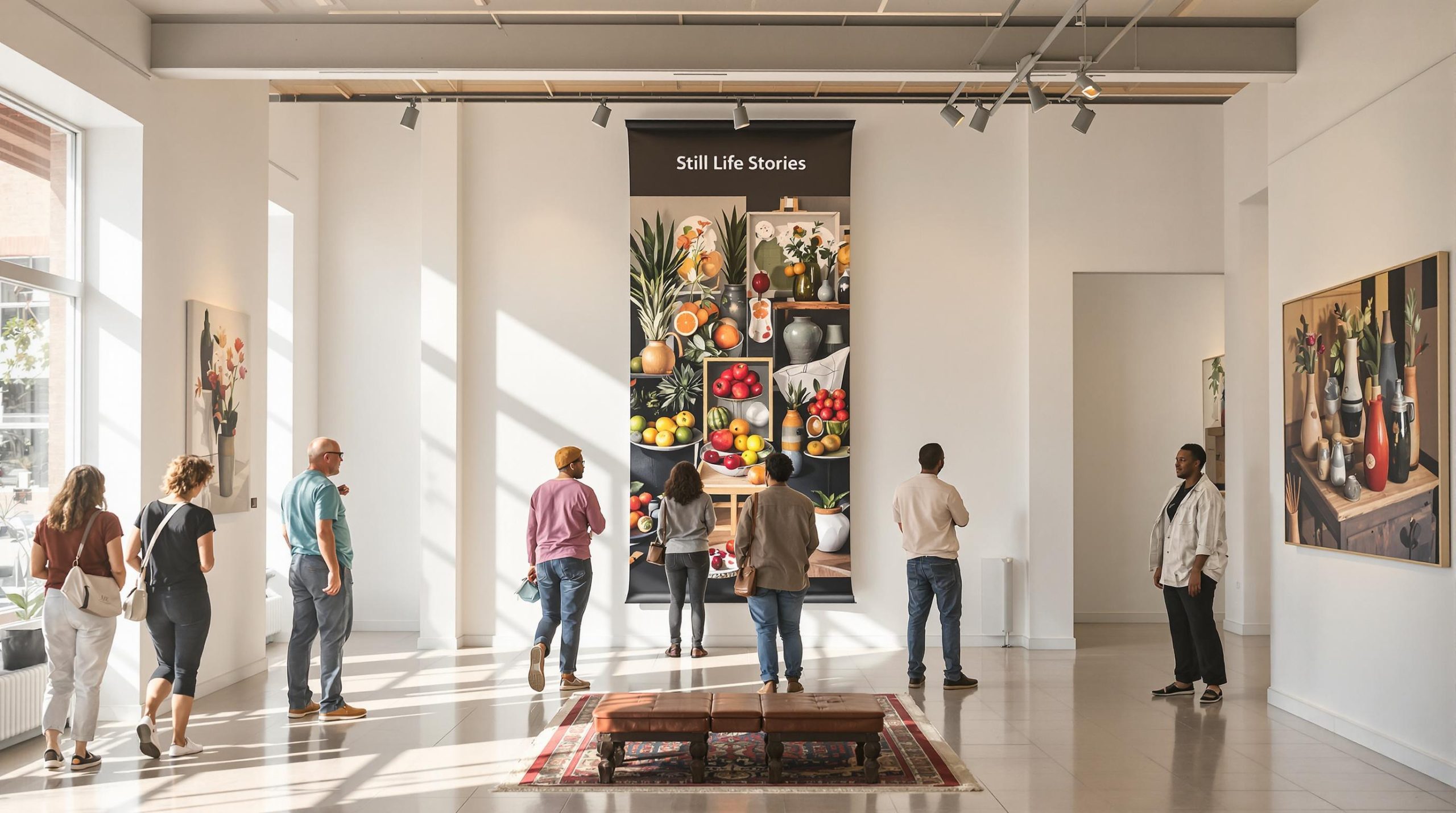
Still life art might seem simple at first glance, with fruit bowls and flowers painted in bright colours. Yet here’s something many people don’t realise. Some ancient tombs in Egypt hold still life paintings dating back over 3400 years, proving this genre is far deeper than décor. So while most folks think of still life as just pretty objects, it actually holds the key to stories about culture, power, and personal identity in South Africa and beyond.
Table of Contents
- Understanding What Is Still Life Art
- History And Evolution Of Still Life
- Popular Still Life Styles In South Africa
- How To Choose Still Life For Decor Or Collection
Quick Summary
| Takeaway | Explanation |
|---|---|
| Understand still life art’s cultural depth | Still life transcends aesthetics, revealing personal and cultural narratives through object representation. |
| Explore historical transformations | The genre’s evolution from ancient to contemporary highlights shifts in cultural and artistic perspectives. |
| Recognise diverse South African styles | South Africa features traditional, modernist, and conceptual still life approaches that reflect its unique heritage. |
| Choose art that resonates personally | Selecting pieces requires emotional connection and consideration of personal cultural narratives for deeper appreciation. |
| Evaluate artwork quality and provenance | Assess artistic merit and authenticity to enhance both the aesthetic and investment value of still life pieces. |
Understanding What Is Still Life Art
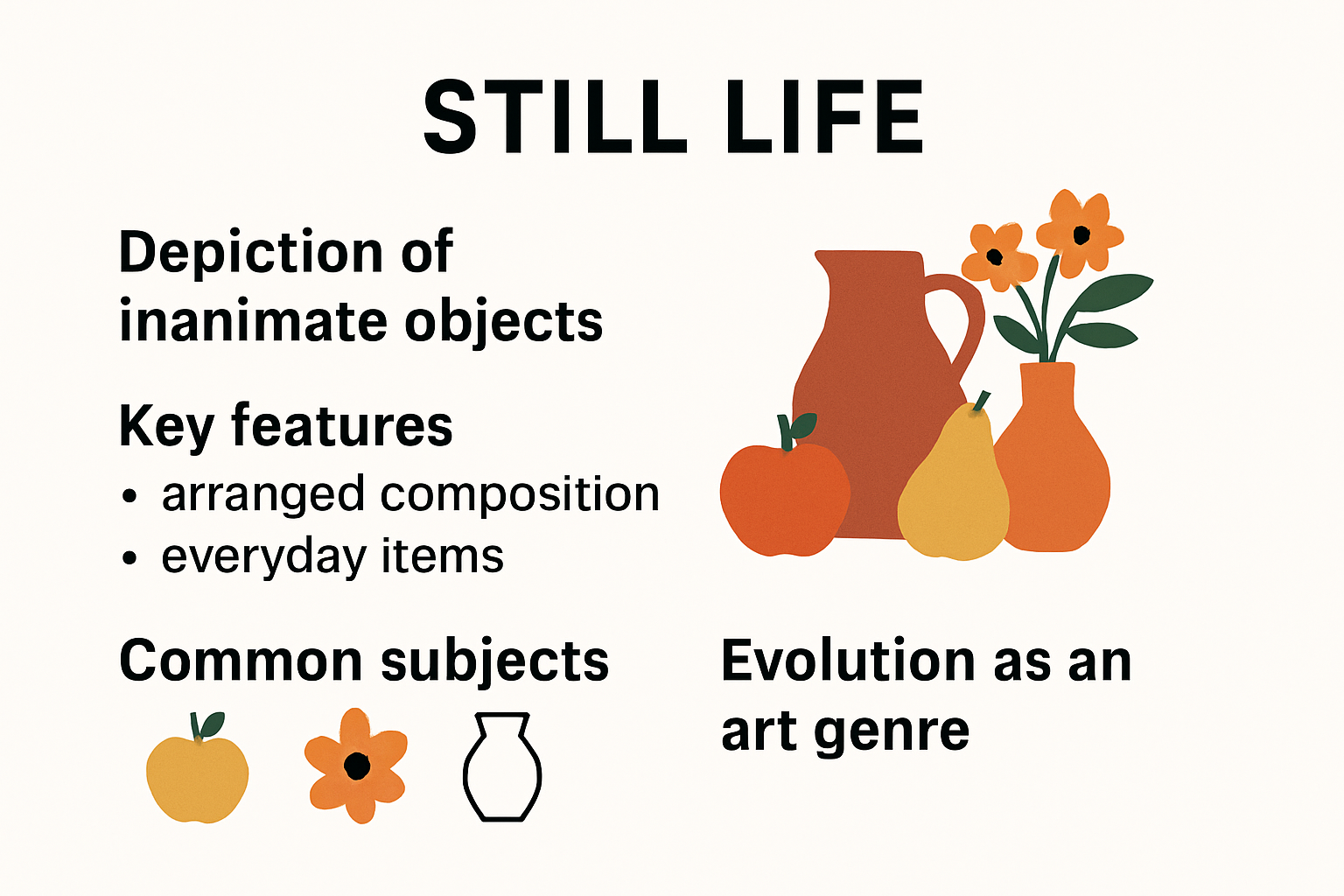
Still life art represents a fascinating genre that captures inanimate objects in carefully composed arrangements, offering profound insights into visual representation and artistic technique. This artistic form transcends mere documentation, transforming ordinary objects into extraordinary visual narratives that reveal deep cultural and personal meanings.
The Essence of Still Life Composition
At its core, still life art involves creating intricate paintings or photographs that depict carefully selected and arranged objects. These objects can range from traditional elements like fruits, flowers, and household items to more contemporary or abstract selections. Exploring artistic techniques reveals that artists use these compositions to explore complex themes of texture, light, symbolism, and human perception.
The arrangement is deliberate and strategic, with each object carefully positioned to communicate specific aesthetic or emotional messages. Artists meticulously consider factors such as color harmony, spatial relationships, lighting, and object interaction. According to The National Gallery, these compositions are not random but carefully constructed visual poems that invite viewers to contemplate the subtle beauty of everyday objects.
Historical and Cultural Significance
Still life art has a rich historical trajectory that extends far beyond simple object representation. Originating in Western art during the late 16th century, this genre emerged as a platform for artists to demonstrate technical mastery and explore deeper philosophical concepts. In the Netherlands, still life paintings often incorporated symbolic elements representing mortality, wealth, or spiritual themes.
For South African art collectors, understanding still life goes beyond aesthetic appreciation. These works reflect cultural narratives, personal histories, and the complex interplay between traditional and contemporary artistic expressions. Artists use everyday objects to communicate nuanced stories about identity, transformation, and social dynamics.
Modern still life artists continue to push boundaries, incorporating diverse materials, unconventional objects, and innovative techniques that challenge traditional perceptions. Whether capturing the luminous quality of local ceramics, the intricate textures of indigenous craft materials, or the symbolic significance of household items, still life art remains a powerful medium for artistic exploration and cultural commentary.
History and Evolution of Still Life
Still life art emerged as a distinctive artistic genre with a complex and fascinating trajectory that spans centuries of creative expression. From its earliest roots to contemporary interpretations, this art form has continuously transformed, reflecting broader cultural and artistic shifts.
Ancient Origins and Early Developments
The origins of still life can be traced back to ancient civilizations, where artists first began documenting everyday objects with remarkable precision. Archaeological evidence from the Tomb of Menna in Egypt reveals intricate wall paintings depicting food, flowers, and household items as early as 1400 BCE. These early representations were not merely decorative but served important ritual and documentary functions.
During the Middle Ages, still life elements often appeared as background details in religious paintings, symbolizing spiritual metaphors. According to The National Gallery, medieval artists used objects to convey complex theological messages, with each item carefully selected to represent moral or religious concepts.
Renaissance and Golden Age Transformation
The Renaissance period marked a significant turning point for still life art. In the Netherlands during the 16th and 17th centuries, still life painting emerged as an independent genre. Artists like Willem Kalf and Willem Claesz Heda developed extraordinary technical skills, creating hyperrealistic representations that celebrated material beauty and explored profound philosophical themes.
Tate Museum research indicates that during this period, still life paintings often incorporated vanitas symbolism – intricate compositions that reminded viewers of life’s transience. Skulls, wilting flowers, and half-eaten fruits became powerful metaphors for mortality and the fleeting nature of earthly pleasures.
Modern and Contemporary Interpretations
In the 20th century, still life art underwent radical transformations. Modernist movements like Cubism and Surrealism reimagined object representation, challenging traditional perspectives. Artists such as Pablo Picasso and Georges Braque deconstructed objects, presenting multiple viewpoints simultaneously and questioning the nature of perception itself.
Contemporary South African artists have continued this innovative tradition, using still life as a medium for exploring cultural identity, social commentary, and personal narratives. They incorporate local materials, traditional objects, and modern techniques to create works that transcend simple representation.
Today, still life remains a dynamic and evolving art form. From photorealistic paintings to conceptual installations, artists continue to find innovative ways to transform ordinary objects into extraordinary visual experiences, inviting viewers to see the world through a fresh, contemplative lens.
Here is a table summarising the main historical phases of still life art as described above:
| Period / Movement | Key Characteristics | Example Artists / Locations |
|---|---|---|
| Ancient Origins (Egypt, 1400 BCE) | Documentary, ritual function; food, flowers, household items | Tomb of Menna, Ancient Egypt |
| Middle Ages | Symbolic religious objects as background; moral/theological messages | European medieval painters |
| Renaissance & Dutch Golden Age | Hyperrealism; technical mastery; vanitas symbolism | Willem Kalf, Willem Claesz Heda (Netherlands) |
| Modernist Movements (20th Century) | Deconstruction, abstraction, exploration of perception | Picasso, Braque |
| Contemporary (Global/South African) | Identity, social commentary, indigenous materials; conceptual art | William Kentridge, Sam Nhlengethwa, Gerard Sekoto |
Popular Still Life Styles in South Africa
South African still life art represents a vibrant and diverse artistic landscape, reflecting the nation’s complex cultural heritage and innovative artistic spirit. The genre encompasses multiple styles that capture the unique visual and emotional textures of South African experience.
Traditional Representational Styles
Traditional still life approaches in South Africa draw heavily from European techniques while incorporating local sensibilities. Research from Iziko Museums reveals that artists like Alexis Preller and Irma Stern developed distinctive styles that blend realistic representation with profound symbolic meanings.
These works often feature meticulously arranged objects that speak to cultural narratives. Typical compositions might include indigenous ceramics, traditional artifacts, local fruits, or household items that represent both personal and collective histories. The attention to detail and rich color palettes characterize these traditional representational styles, inviting viewers to explore deeper cultural connections.
Modernist and Abstract Interpretations
Contemporary South African artists have significantly expanded the boundaries of still life art. According to the exhibition ‘Is There Still Life?’, artists like William Kentridge and Sam Nhlengethwa have transformed the genre through modernist and abstract approaches. These artists deconstruct traditional representations, using objects as metaphors for social commentary and personal expression.
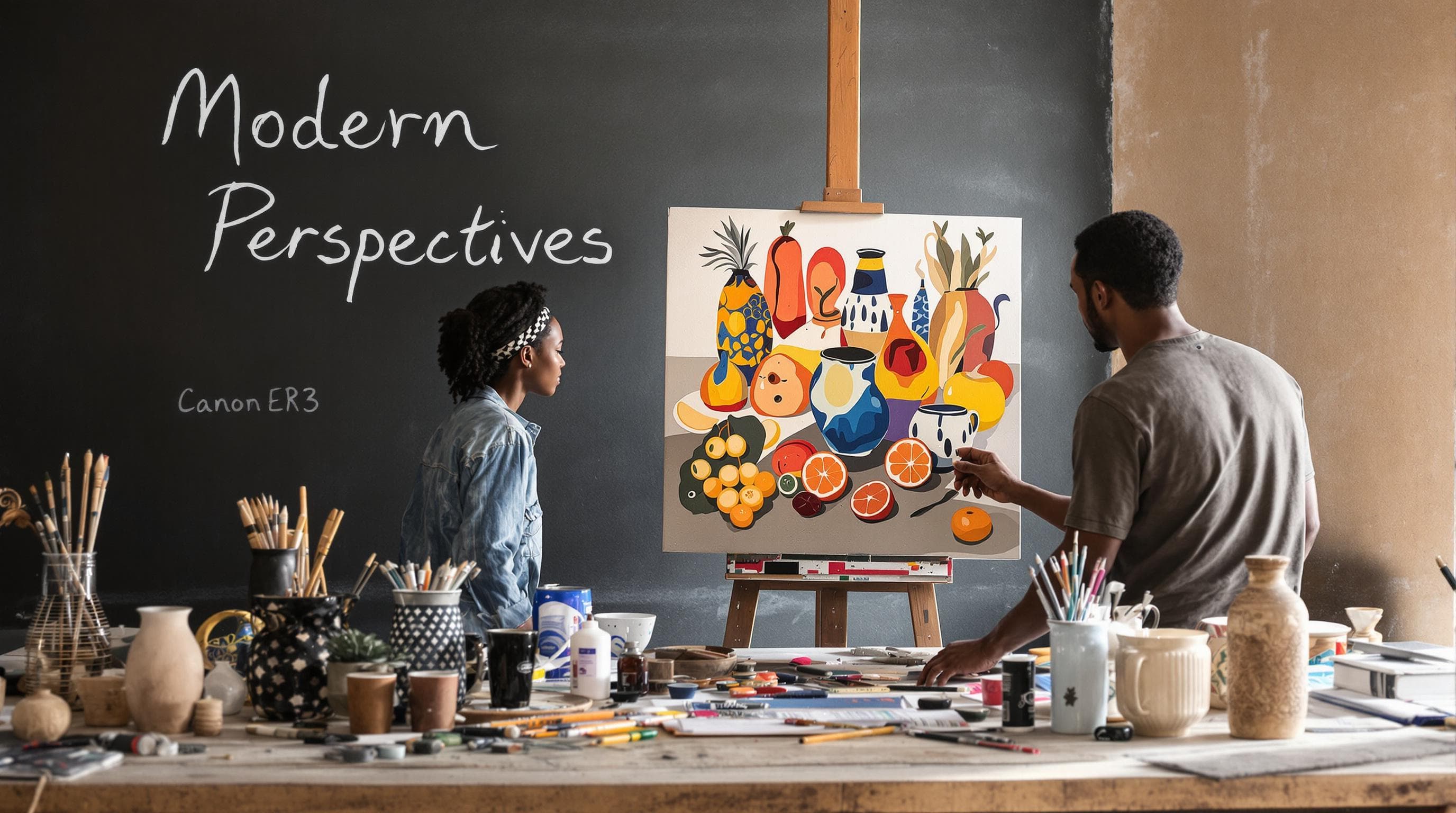
Modernist still life styles in South Africa often incorporate mixed media, experimental techniques, and politically charged imagery. Artists challenge viewers’ perceptions by fragmenting objects, using unconventional color schemes, and introducing elements that disrupt traditional compositional norms. Explore notable South African artists to understand the depth and complexity of these innovative approaches.
Contemporary Conceptual Expressions
Contemporary South African still life art has evolved into a powerful medium for exploring identity, social dynamics, and cultural transformation. Artists now use objects not just as visual subjects but as complex narrative devices. They select and arrange items that speak to personal histories, post-apartheid experiences, and ongoing social negotiations.
This approach transforms still life from a purely aesthetic practice into a profound form of storytelling. Objects become charged with meaning – a traditional basket might represent cultural preservation, while a discarded industrial item could symbolize economic shifts. Contemporary artists like Gerard Sekoto have pioneered these conceptual approaches, using everyday objects to communicate nuanced social commentaries.
These diverse styles demonstrate that South African still life art is far more than a simple documentation of objects. It is a dynamic, evolving form of artistic expression that captures the nation’s complex identity, reflecting personal experiences, cultural memories, and ongoing social transformations.
Below is a table comparing the main still life styles found in South Africa and their key features:
| Style | Key Features | Notable Artists |
|---|---|---|
| Traditional Representational | Realistic depiction, cultural objects, rich local symbolism | Alexis Preller, Irma Stern |
| Modernist & Abstract | Mixed media, deconstruction, experimental, social commentary | William Kentridge, Sam Nhlengethwa |
| Contemporary Conceptual | Narrative objects, focus on identity/social themes, symbolism | Gerard Sekoto, emerging SA artists |
How to Choose Still Life for Decor or Collection
Selecting the right still life artwork requires a nuanced approach that balances personal aesthetic preferences, spatial considerations, and artistic value. For South African collectors and interior decorators, choosing still life art is an intimate process of connecting with visual narratives that resonate on multiple levels.
Evaluating Artistic Quality and Provenance
Understanding the artwork’s background is crucial when making a selection. The BBC Bitesize guide suggests looking for compositions that demonstrate technical mastery, such as pieces with harmonious object arrangements and compelling visual relationships. Collectors should examine the artwork’s composition, focusing on elements like color harmony, balance, and the artist’s unique perspective.
Authenticity and provenance play significant roles in art selection. Research the artist’s background, examine the artwork’s history, and verify its authenticity. For South African still life pieces, consider works that reflect the nation’s rich cultural landscape and artistic traditions. Understanding an artwork’s context can enhance its value and personal significance.
Matching Artwork with Space and Aesthetic
Discovery Homes advises considering the specific function and mood of each room when selecting artwork. Different spaces require different artistic approaches. A living room might benefit from a bold, conversation-starting still life, while a bedroom could be complemented by a more serene, subdued composition.
Size and proportion are critical considerations. Measure your wall space and select artwork that complements your existing decor. An oversized piece can overwhelm a room, while a too-small artwork might appear insignificant. Consider the visual weight of the artwork and how it interacts with surrounding furniture and architectural elements.
Personal Connection and Emotional Resonance
Lauren Sauder emphasizes the importance of selecting artwork that creates a personal emotional connection. Beyond technical considerations, the most meaningful still life pieces are those that speak to you on an intuitive level.
Consider the narrative and emotional landscape of the artwork. Does it evoke memories? Does it reflect aspects of your cultural identity? South African still life art offers rich opportunities for personal and cultural exploration. Look for pieces that tell stories, challenge perspectives, or capture the essence of local experiences.
Additionally, consider the artwork’s potential as an investment. While emotional connection is paramount, pieces by established South African artists or emerging talents with significant potential can appreciate in value. Explore collections by notable South African artists to discover unique and valuable still life artworks that might become cherished parts of your collection.
Frequently Asked Questions
What is still life art?
Still life art is a genre that depicts inanimate objects arranged in a composition. It can include items like fruits, flowers, and household objects, serving as a medium for exploring deeper cultural and personal meanings.
How has still life art evolved over time?
Still life art has evolved from ancient representations in civilizations like Egypt to independent genres during the Renaissance. In modern times, it has incorporated abstract interpretations and conceptual art, with contemporary artists exploring themes of identity and social commentary.
What are popular still life styles in South Africa?
Popular still life styles in South Africa include traditional representational art, modernist approaches, and contemporary conceptual expressions. Each style reflects the country’s unique cultural heritage and evolving artistic narratives.
How do I choose still life art for my collection or decor?
When selecting still life art, consider evaluating artistic quality, ensuring the piece matches your space’s aesthetic, and choosing artworks that resonate emotionally with you. Understanding provenance and the cultural significance behind the artwork can also enhance your appreciation.
Bring South African Still Life Into Your Collection with Confidence
Have you ever struggled to find a still life artwork that truly speaks to your personal story and fits your space? Many collectors in South Africa worry about authenticity, quality, or choosing art that genuinely reflects their cultural identity. If you have been inspired by the ideas in our guide – from the emotional importance of still life to the value of local artists – you do not have to search blindly. Art Online is your trusted source for discovering genuine South African still life art that matches both your taste and the unique cultural narratives explored in our article.

Explore our curated selection today on Art Online. Shop artworks from well-known and emerging South African artists and experience the satisfaction of owning pieces with real provenance and meaning. Do not miss this opportunity to start or grow your collection with art that captures your story – see what is available now.
Recommended
- Famous South African Artists: 2025 Guide for Collectors & Decorators – Art-Online
- South African Tribal Art: Trends and Decor Ideas for 2025 – Art-Online
- Blog – Art-Online
- Why Buy Original Art in South Africa: Key 2025 Insights – Art-Online
- South African Wine Regions to Discover in 2025 | Vinty Guide